Prerequisites
Before running the Get-ADUser cmdlet, ensure you have:
- RSAT (Remote Server Administration Tools) installed
- Active Directory module imported (Import-Module ActiveDirectory)
- Appropriate domain permissions to query AD
- PowerShell 3.0 or later (Windows Server 2008 R2 SP1 and later)
How to List All Active Directory Users with PowerShell
Run the following script changing the export path:
$ExportPath = 'c:\adusers_list.csv’
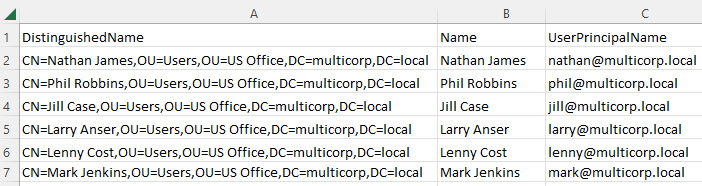
Get-ADUser -Filter * | Select-object DistinguishedName,Name,UserPrincipalName | Export-Csv -NoType $ExportPath
This PowerShell script does the following:
- Creates a variable “$ExportPath” and sets its value to the file path “c:\adusers_list.csv”.
- Uses the “Get-ADUser” cmdlet to retrieve all AD user accounts.
- Select the properties “DistinguishedName”, “Name”, and “UserPrincipalName” of each user.
- Exports the selected properties to a CSV file using the “Export-Csv” cmdlet, with the “-NoType” switch to exclude the type information in the file.
- The final file will be saved at the specified path in the “$ExportPath” variable.
Open the CSV file generated from the script in Excel to see the results:
Common Get-ADUser Parameters
Common Variations
How Lepide Change Reporter for Active Directory (Free Tool) Helps
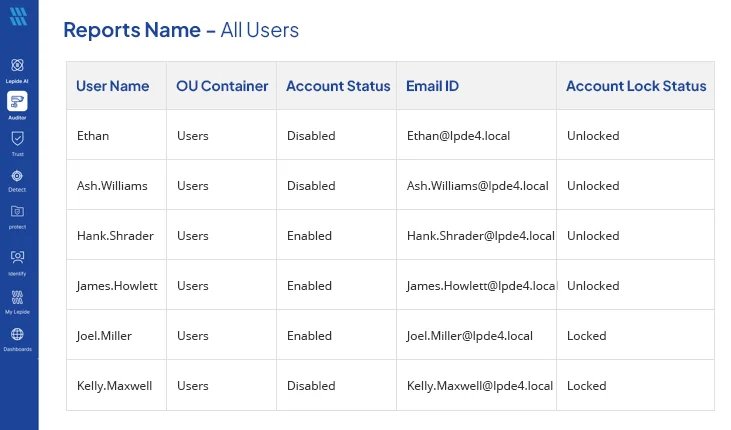
An alternative, more straightforward solution to the native method is to use Lepide Change Reporter for Active Directory, a free tool that lists all current Active Directory users..
Frequently Asked Questions
What module is required for Get-ADUser?
How do I export AD users to CSV?
What permissions are needed to run Get-ADUser?
Which Windows Server versions support Get-ADUser?
Why Monitor Active Directory Users?
As an administrator, it is essential to always be looking for any activity that deviates from normal as this could be indicative of an attack. Users with sufficient administrative rights can create any number of user accounts in Active Directory and these accounts can then be used to manipulate or steal sensitive data. It is, therefore, crucial to regularly monitor and track Active Directory account activity to prevent malicious users from causing a data breach.