External sharing in SharePoint Online allows users outside your organization to access content through direct invitations or anonymous links. SharePoint is a very powerful solution when used correctly. It enables teams to collaborate efficiently and provides an invaluable platform for sharing and storing internal data. External sharing in SharePoint Online is very easy as well. Depending on your organization’s external sharing settings, access can be provided to specific external users or through Anyone links, which allow anyone with the link to access the content without signing in. However, to minimize serious security risks, including leaks of sensitive data, SharePoint administrators must carefully monitor all external sharing to ensure that content is protected and compliance regulations are not breached.
Unmonitored external sharing can expose your organization to significant security risks and compliance violations, particularly for regulations like GDPR and HIPAA that require strict control over data access and sharing.
Key Limitation: There is no SharePoint Online external sharing report available natively at the tenant level. To achieve this, you must generate the Shared with external users report from each SharePoint site individually. But to get a full view of external sharing across your Office 365 tenant, you’ll need to generate this summary for each site collection separately, combine the results, and then manually filter out External and Anonymous shares.
If you use Microsoft Purview Audit logs to investigate sharing activity, a single sharing action may generate multiple audit events, requiring additional correlation during investigations.
Native Method
As it is not possible to generate a report on external sharing across your entire tenant, you will have to generate and download a report for each SharePoint site collection separately. The steps to do this are as follows:
- Open the site you want to report on.
- Click the cog icon to open the Settings menu.
- Select Site usage.
- Scroll down to the Shared with external users section.
- Click Run report.
- Pick a location to save the report and click Run report.
- Browse to the SharePoint Online location where you chose to save the report.
- Review the CSV report in Excel. If necessary, filter out internal groups such as Owners, Members, and Visitors to focus on externally shared content.
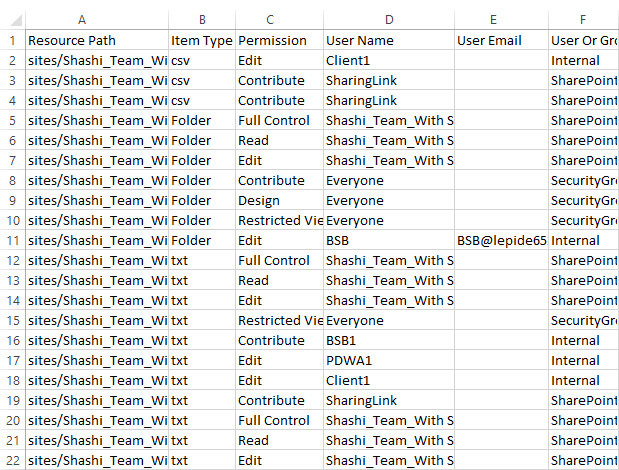
The report includes information such as the shared item, recipient, permission level, sharing link (where applicable), and sharing date. The exact columns may vary over time as Microsoft updates the report.
Outcome: This produces a CSV file listing all externally shared files, recipients, and sharing dates for that specific site collection.
Using the Lepide SharePoint Auditor
A more straightforward way to get a SharePoint Online external sharing report is to use Lepide Auditor for SharePoint. Here you can run the External Data Sharing in Office 365 report to see all external sharing across your Office 365 tenant: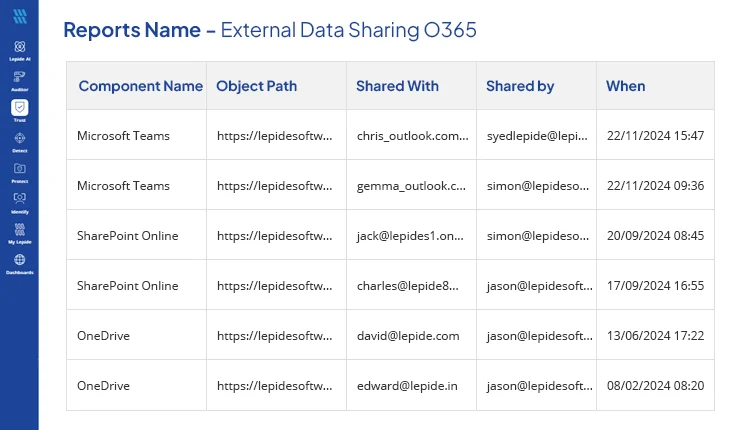
The report includes information about the Component Name, What was shared, who it was Shared With, who it was Shared By, When it was shared and Where.
To run the report:
- From the Permissions & Privileges screen, select External Data Sharing O365
- Specify a date range in the When filter and click Generate Report
- The report can be sorted, filtered, exported, and saved
Native Method vs. Lepide Auditor Comparison
Frequently Asked Questions
No. Microsoft does not provide a native tenant-wide external sharing report. You must generate the report for each SharePoint site and manually consolidate the results if you need a tenant-wide view.
Information about shared items, recipients, permission levels, and sharing dates. The exact fields may vary depending on Microsoft updates.
To prevent data leaks, maintain security, and ensure compliance with regulations like GDPR and HIPAA.