User activity monitoring is the process of tracking and recording user actions, such as logons, logoffs, and privilege usage, within Windows systems to detect suspicious behavior and maintain security compliance. Understanding what your users are doing in your critical systems is a crucial part of identifying potential suspicious behavior leading to security breaches. Tracking user activity provides the necessary information to spot malicious activity and stop an organization from falling prey to a potential cyberattack.
Native Active Directory auditing tools can be used to monitor user activity, but it is a time-consuming and often complex task. Lepide Auditor overcomes the limitations of native auditing by giving you the visibility you need to detect and react to insider threats quickly and efficiently.
In this article, we will look at two methods for tracking user activity: the native auditing method (Event Log) and an automated solution using Lepide Auditor.
Track User Activity in Windows Computers using Event Logs
Prerequisites
Before configuring user activity monitoring, ensure the following requirements are met:
- Supported Windows Server Versions: Windows Server 2012 R2, 2016, 2019, or 2022
- Administrative Permissions: Domain Admin or equivalent privileges to modify Group Policy Objects
- Dependencies: Group Policy Management Console (GPMC) installed; Event Viewer access on target systems
Please follow below steps:
-
- Enable Audit Policy in Group Policy Management Console
- Select Server Manager on Windows server.
- Under the Manage tab, open the Group Policy Management console.
- Go to Forest, Domain, Your Domain, Domain Controllers.
- You can either edit an existing group policy object or create a new one.
- In the Group Policy Editor, navigate to Computer Configuration, Policies, Windows Settings, Security Settings, Local Policies, Audit Policy.
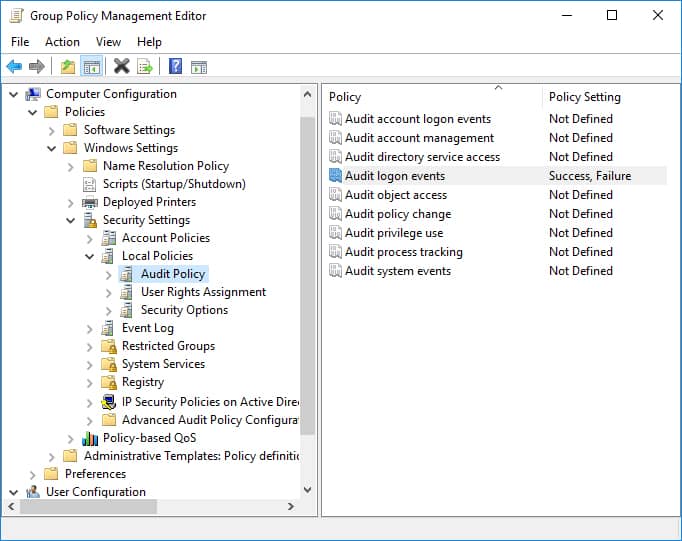
- In Audit Policy, select Audit logon events and enable Success and Failure auditing.
- Enable Audit Policy in Group Policy Management Console
PowerShell Alternative
auditpol /set /subcategory:"Logon" /success:enable /failure:enable-
- Enable Logon/Logoff Auditing in Advanced Audit Policy
- Go back to Computer Configuration. Navigate to Windows Settings, Security Settings, Advanced Audit Policy Configuration, Audit Policy, Logon/Logoff
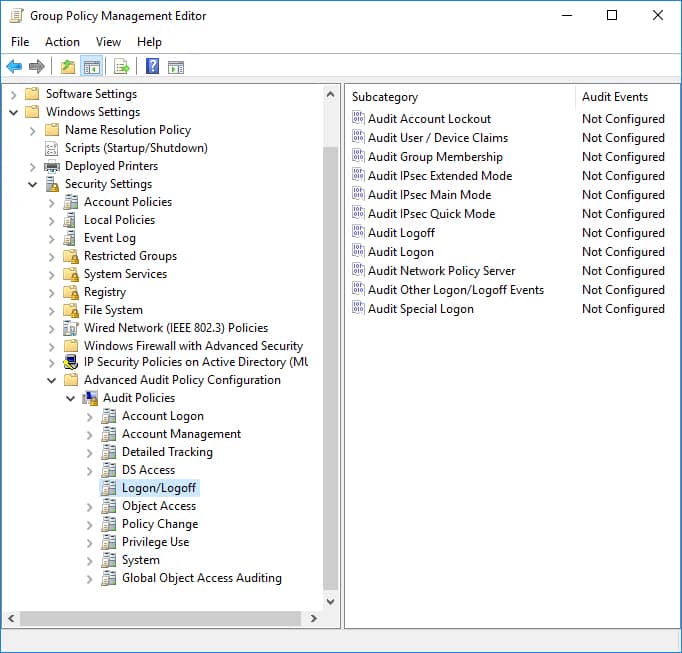
- Next, enable Success and Failure auditing for Audit Logon, Audit Logoff, and Audit Special Logon.
- Open the Group Policy Management console and select the GPO that you have edited or created.
Under Security Filtering, add the users whose logons need to be tracked. You can also choose to audit every domain user’s logon by selecting All users. To audit, a group of domain users, the specific group(s) can be added.
- Go back to Computer Configuration. Navigate to Windows Settings, Security Settings, Advanced Audit Policy Configuration, Audit Policy, Logon/Logoff
- Enable Logon/Logoff Auditing in Advanced Audit Policy
PowerShell Alternative
auditpol /set /subcategory:"Logoff" /success:enable /failure:enable
auditpol /set /subcategory:"Special Logon" /success:enable /failure:enable-
- Navigate Event Viewer to Check Security Logs
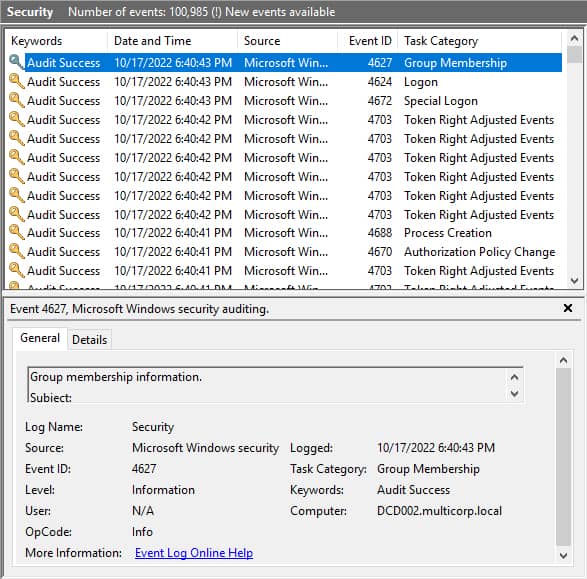
- Open Event Viewer and navigate to Windows logs, Security.
- Look for the event IDs:
- Filter Logs by Event ID or Time Range
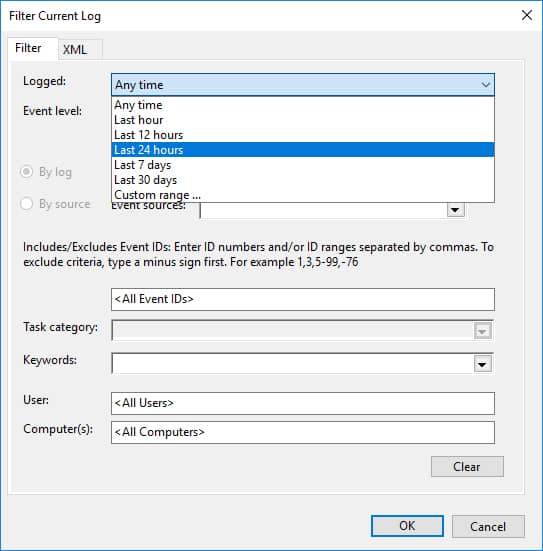
- Click Filter Current Log on the right side to filter the logs based on event IDs or the time range for which the information is required.
- System admins have to go through the list of logon times and identify suspicious patterns if any. This is a tedious and error-prone process as there is a high chance that some logs may be overlooked.
- Click Filter Current Log on the right side to filter the logs based on event IDs or the time range for which the information is required.
- Navigate Event Viewer to Check Security Logs
PowerShell Alternative to Query Events:
Get-WinEvent -LogName Security -FilterXPath "*[System[EventID=4624]]" | Select-Object -First 50Common Native Auditing Issues and Troubleshooting
Monitor User Activity in Windows Computers Using the Lepide Auditor
Lepide Auditor for Active Directory overcomes the complexity of the native method by providing a straightforward way to identify suspicious insider activity using Active Directory by using Logon/Logoff Reporting and the Permissions Modification Report.
Lepide Auditor for Active Directory includes several Logon/Logoff reports to track logon activity. Two of these reports are Failed User Logon and Successful User Logon/Logoff Reports.
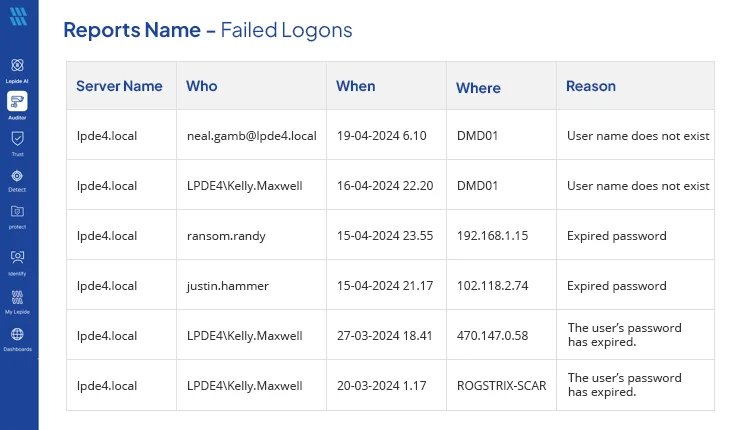
How to run the Failed Logon Report:
- Click the User & Entity Behavior Analytics icon and select Active Directory Reports, Logon/Logoff Reports, Failed Logon
- Select a Date Range and click Generate Report
- The report is generated and can be sorted, filtered, grouped, saved, and exported.
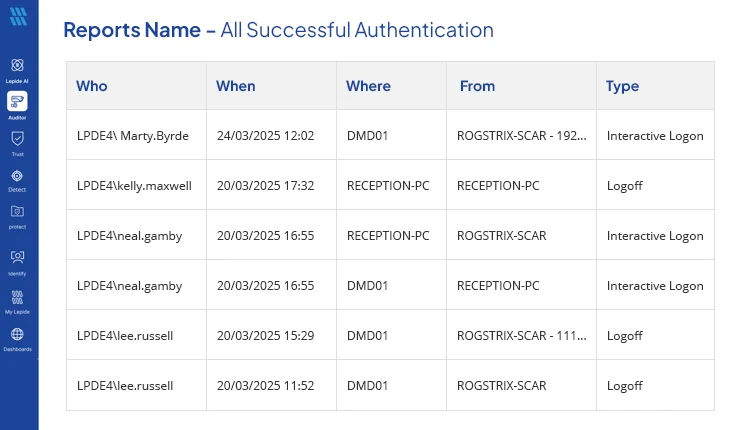
How to run the Successful User Logon/Logoff Report:
- Click the User & Entity Behavior Analytics icon and select Active Directory Reports, Logon/Logoff Reports, Successful User Logon/Logoff
- Select a Date Range and click Generate Report
- The report is generated and can be sorted, filtered, grouped, saved, and exported.
Native Event Logs vs. Lepide Auditor: Comparison
Frequently Asked Questions
Native auditing requires manual log review, lacks centralized reporting across multiple systems, and can generate overwhelming volumes of data that make identifying threats difficult without additional tools.
By default, the Security log is set to overwrite events as needed when it reaches its maximum size (typically 20 MB). Organizations should configure log retention policies or forward logs to a SIEM for long-term storage.
For enterprises with hundreds or thousands of endpoints, automated solutions like Lepide Auditor provide centralized visibility, pre-built reports, and real-time alerting that scale effectively across distributed environments.