


Last Updated on August 12, 2026 by Satyendra
A data security platform discovers, classifies, and protects sensitive data across an organization’s IT environment, while providing security teams with visibility into who can access it and how it’s used.
This blog compares 10 leading data security platforms for unstructured data so you can see what each does well, where it falls short, and who it’s best suited for.
The Security Risks of Unstructured Data
Unstructured data lacks a consistent schema and is distributed across multiple repositories, making it difficult for traditional security tools to discover, classify, and monitor comprehensively. The nature of unstructured data makes it difficult to analyze and even more difficult to secure. Organizations lack visibility into it, and it can sprawl as users generate more of it. The data typically lives across file servers, SharePoint, OneDrive, Teams, Exchange, and cloud storage such as AWS S3, Google Cloud Storage, and Azure Blob Storage, each with its own permissions model and audit format.
It introduces security risks, such as compliance violations and breaches, if an organization has no proactive approach to managing it. DSPM helps organizations discover sensitive data, assess exposure, and prioritize remediation. However, DSPM may not provide the same permission-governance, activity-monitoring, or DLP capabilities as a broader data security platform. Organizations need centralized visibility – one place to see where sensitive data resides, who can access it, and what users are doing with it. A data security platform can centralize this information across the repositories it supports.
How We Selected the Best Data Security Platforms
To select the best data security platforms, we looked at the core capabilities that matter most for securing unstructured data:
- Data Discovery & Classification: Sensitive information such as PII, PHI, and financial records must be precisely located and labeled by the platform wherever it resides. This includes the capacity to identify and precisely categorize sensitive data, including whether classification uses rules, pattern matching, exact data matching, document fingerprinting, OCR, contextual analysis, or machine-learning-assisted methods
- Permission Analysis: Assessing how a platform discovers, calculates effective access, resolves nested group membership, identifies inherited permissions, and detects excessive or stale entitlements against sensitive data assets. Monitor visibility into effective access rights, nested groups, and excessive or stale entitlements.
- Threat Detection: The ability to spot suspicious user activity and potential data exposure in real time or near real time, depending on repository and audit-data availability. AI-driven anomaly detection, speed of alerts, and integration with existing security systems.
- Coverage & Integration: Evaluating a data security platform requires a rigorous framework focused on comprehensive data coverage across multi-cloud and on-premises environments, alongside SIEM integration capabilities.
- Usability: When selecting the best data security platform, usability focuses on how easily security and data teams can deploy, manage, and use the tool without extensive training.
Comparison Table – Best Data Security Platforms at a Glance
| Platform | Platform Type | Discovery & Permission Visibility | Monitoring & Enforcement | Best For |
|---|---|---|---|---|
| Lepide Data Security Platform | Data security and access governance | Strong discovery, classification, effective-permission analysis, and excessive-access identification | User-activity monitoring, contextual alerts, and permission-remediation workflows | Microsoft-centric hybrid environments requiring data and access visibility |
| Varonis Data Security Platform | Data security platform and DSPM | Strong discovery, classification, exposure analysis, and data-access governance | Behavioral analytics, threat detection, DLP, and automated remediation | Large enterprises with complex cloud, SaaS, NAS, database, and Microsoft environments |
| Microsoft Purview | Data security, governance, compliance, and DLP suite | Strong classification and labeling; permission visibility varies by repository | Insider-risk monitoring, DLP enforcement, DSPM, and security investigations | Organizations invested in Microsoft 365, Azure, Fabric, and Microsoft Security |
| Netwrix Auditor | Auditing and change monitoring | Strong permission and change visibility; Sensitive Data Discovery is an integration between Netwrix Auditor and Netwrix Data Classification | User-activity auditing, alerts, investigation, and compliance reporting | Organizations prioritizing auditing, change tracking, and compliance evidence |
| IBM Guardium | Enterprise data-security product family | Strong structured and unstructured-data discovery; limited file-system permission governance | Data-activity monitoring, threat detection, protection, and compliance through relevant components | Large enterprises securing databases and complex hybrid data estates |
| Symantec DLP | Enterprise DLP platform | Strong content discovery and classification; limited effective-permission analysis | Endpoint, network, email, web, storage, and cloud DLP enforcement | Enterprises requiring comprehensive data-loss prevention |
| Forcepoint Data Security Cloud | DSPM, DLP, and data-risk platform | Strong discovery and classification; DSPM, DLP, and Data Detection and Response may require separate Forcepoint products or licensing. | Behavioral monitoring, Data Detection and Response, and risk-adaptive DLP | Regulated enterprises requiring integrated DSPM and DLP |
| Trellix Data Loss Prevention | Enterprise DLP suite | Strong data discovery and classification; limited access-governance capabilities | Granular endpoint, network, device, email, web, and cloud controls | Enterprises controlling sensitive-data use and movement |
| Spirion Sensitive Data Platform | Sensitive-data discovery and governance | Strong discovery, persistent classification, and Remediation workflows can use access-control-list attributes and other metadata; buyers should separately validate effective-permission calculation requirements | Automated remediation workflows; limited behavioral threat monitoring | Privacy- and compliance-driven organizations reducing sensitive-data exposure |
| Fortra DLP | Endpoint, network, cloud, and discovery DLP | Strong content discovery; limited effective-permission analysis | Endpoint activity monitoring plus network, cloud, and policy-based enforcement | Organizations protecting intellectual property and regulated data, particularly on endpoints |
Top 10 Data Security Platforms for Protecting Unstructured Data
Below is a curated list of the top data security platforms that help organizations discover sensitive data, reduce exposure, and protect information across on-premises and cloud environments.
1. Lepide Data Security Platform
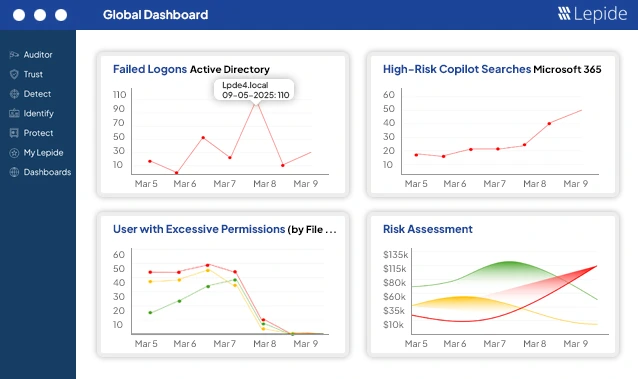
Overview: Lepide Data Security Platform helps organizations discover sensitive unstructured data and connect it with identity, permission, and user-activity information across supported on-premises and Microsoft cloud workloads. Its capabilities include auditing, sensitive-data discovery, effective-permission analysis, risk monitoring, access governance, and compliance reporting.
Key Features
- Sensitive-data discovery and classification
- Effective-permission and access-path analysis
- Active Directory and Microsoft Entra ID auditing
- Windows file server and Microsoft 365 activity monitoring
- Alerts for suspicious changes and user activity
- Access-governance and permission-remediation workflows
- Preconfigured audit and compliance reports
Pros: Connects identity, data sensitivity, permissions, and user activity in one platform. Particularly relevant to hybrid environments built around Active Directory, Windows file systems, and Microsoft 365.
Cons: Organizations with extensive database, multicloud object-storage, or non-Microsoft SaaS requirements should confirm repository-specific coverage. Deployment effort and cost depend on scope and licensing.
Best For: Organizations that need sensitive-data discovery, permission analysis, auditing, and remediation across supported Microsoft-centric hybrid environments.
2. Varonis Data Security Platform
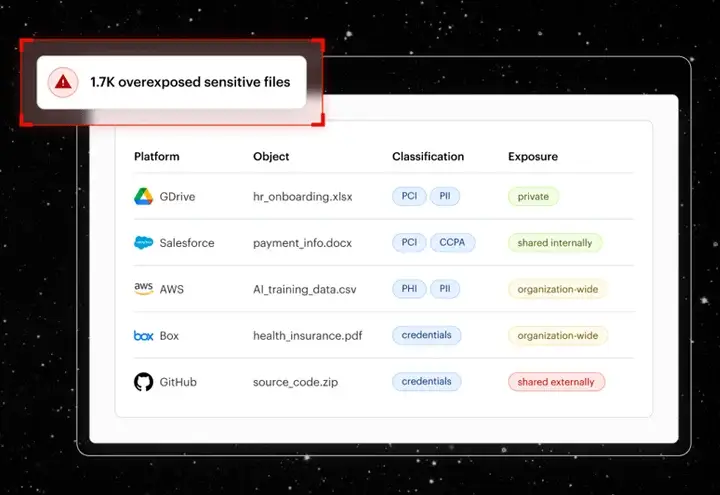
Overview: Varonis is a data security platform that discovers and classifies sensitive data, analyzes exposure, monitors data activity, and automates remediation across supported cloud, SaaS, database, Windows, NAS, and Microsoft 365 environments.
Key Features
- Sensitive-data discovery, classification, and labeling
- Permission and exposure analysis
- Data-centric user and entity behavior analytics
- Data-access governance and access-review workflows
- Automated remediation of permissions and misconfigurations
- Data lifecycle actions, including supported labeling, quarantine, migration, and deletion
- Coverage for supported Microsoft 365, Windows, NAS, SaaS, cloud, and database sources
Pros: Broad repository coverage combined with deep permission context, behavioral analytics, and automated exposure reduction.
Cons: The platform’s broad scope may require careful implementation, licensing, and operational planning. Buyers should verify capability depth and licensing for every required data source.
Best For: Large or complex organizations that need automated data discovery, access governance, activity monitoring, and exposure remediation across multiple repositories.
3. Netwrix Auditor
Overview: Netwrix Auditor is an auditing and change-monitoring platform that provides visibility into user activity, configuration changes, permission changes, and access events across supported identity systems, file repositories, applications, and infrastructure.
Key Features
- Change and access auditing
- User-activity monitoring and alerting
- Permission and configuration-change reporting
- Preconfigured compliance reports
- Searchable audit trails and investigation data
- Sensitive-data reporting through integration with Netwrix Data Classification
- Support for selected on-premises and cloud systems
Pros: Strong auditing, change tracking, alerting, and compliance reporting. It can add sensitive-data context when integrated with Netwrix Data Classification.
Cons: Sensitive-data discovery is not a standalone native capability of Netwrix Auditor; it requires integration with Netwrix Data Classification. PAM, DLP, ITDR, and advanced access governance may require other Netwrix products.
Best For: Organizations prioritizing auditing, change monitoring, access visibility, investigations, and compliance reporting.
4. Microsoft Purview
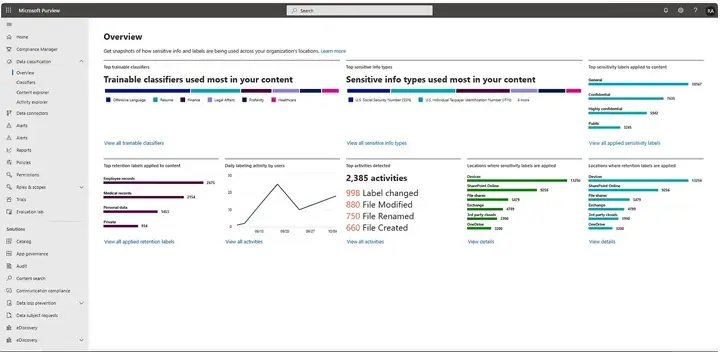
Overview: Microsoft Purview is a suite of data security, governance, risk, and compliance capabilities. It helps organizations discover, classify, label, monitor, and protect sensitive data across supported Microsoft 365 services, endpoints, browsers, networks, Microsoft Fabric, Copilot, and connected data sources.
Key Features
- Information Protection and sensitivity labels
- Data Loss Prevention across supported services and devices
- Insider Risk Management
- Data Security Posture Management
- Data Security Investigations
- Content Explorer and Activity Explorer
- Integration with Microsoft Defender XDR and Microsoft Sentinel
- Data-governance and compliance capabilities
Pros: Native integration across Microsoft 365 and the wider Microsoft security ecosystem. Combines content classification, DLP, insider-risk context, investigations, and governance.
Cons: Licensing and configuration can be complex. Deep effective-permission analysis across heterogeneous NTFS, NAS, and non-Microsoft repositories is not its primary strength. Some endpoints and external sources require onboarding, connectors, or additional components.
Best For: Organizations heavily invested in Microsoft 365, Azure, Microsoft Fabric, and Microsoft security products.
5. IBM Guardium
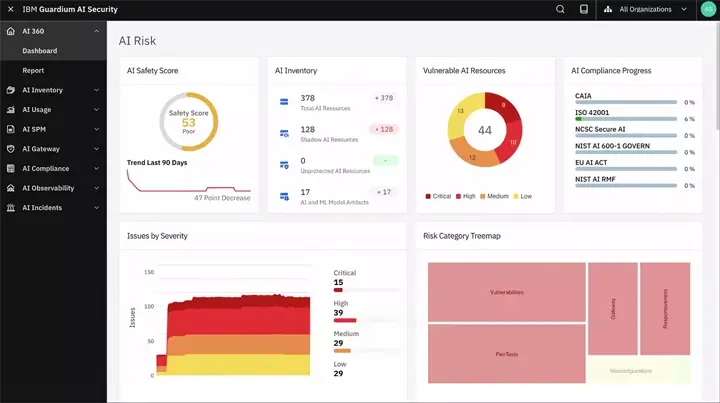
Overview: IBM Guardium is an enterprise data-security product family that provides discovery, classification, activity monitoring, protection, and compliance capabilities across supported hybrid and multicloud data environments. Individual capabilities are delivered through components such as Guardium Discover and Classify and Guardium Data Protection.
Key Features
- Data discovery and classification of structured and unstructured data
- Coverage for supported data at rest and in motion
- Database and data-store activity monitoring through relevant Guardium components
- Sensitive-data risk and exposure assessment
- Threat detection and alerting
- Compliance reporting and audit trails
- Hybrid and multicloud data-store integrations
Pros: Broad enterprise data-security coverage, particularly for structured data, databases, hybrid data stores, and regulatory monitoring.
Cons: Guardium is a product family rather than a single uniform DSPM tool. Discovery, monitoring, protection, and compliance functions may require different components, licensing, and implementation expertise. Deep file-system permission governance should be validated for each repository.
Best For: Large enterprises that need sensitive-data discovery, database monitoring, compliance controls, and protection across complex hybrid data environments.
6. Symantec DLP (Acruired by Broadcom)
Overview: Symantec Data Loss Prevention, provided by Broadcom, discovers, monitors, and protects sensitive data across supported endpoint, email, web, network, storage, cloud, SaaS, and AI-use channels. Its primary focus is preventing unauthorized data use and movement rather than governing file-system permissions.
Key Features
- Data-at-rest discovery scanning
- Content inspection and policy-based classification
- Exact data matching and document fingerprinting
- Endpoint, network, email, web, storage, and cloud DLP
- Controls for removable media, printing, applications, and network protocols
- Policy-based blocking and incident response
- Cloud DLP and CASB-related capabilities
Pros: Mature DLP capabilities with extensive content-detection methods and broad coverage across major data-loss channels.
Cons: Deployment, policy design, incident tuning, and false-positive reduction can require substantial expertise. It is not primarily designed for complex effective-permission analysis or access-governance remediation.
Best For: Large organizations that need enterprise DLP across endpoints, networks, storage repositories, email, web, and cloud channels.
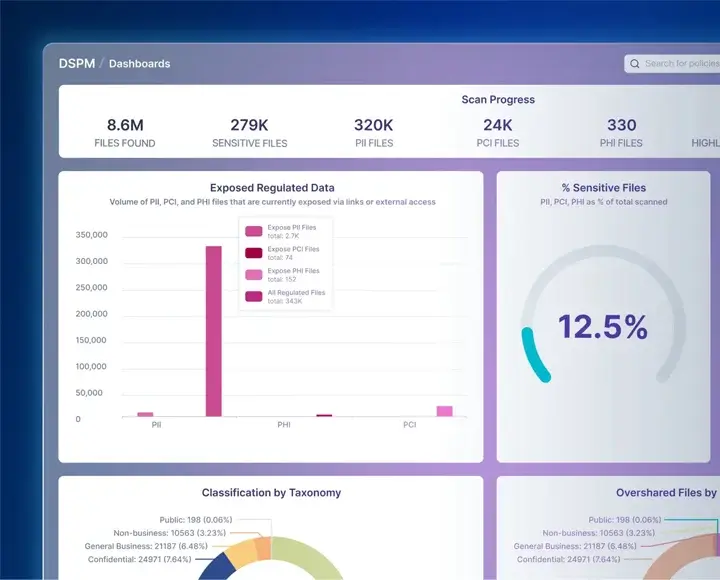
7. Forcepoint Data Security Cloud
Overview: Forcepoint Data Security Cloud combines data discovery, classification, posture assessment, activity monitoring, DLP, and risk-adaptive enforcement. Its product family includes Forcepoint DSPM, Forcepoint DLP, and Data Detection and Response capabilities.
Key Features
- Discovery, classification, and tagging of sensitive data
- DSPM across supported cloud and on-premises sources
- Endpoint, network, web, email, and cloud DLP
- Data Detection and Response
- User-risk and behavioral context
- Risk-adaptive policy enforcement
- Unified policy management across supported data channels
- Classification support for structured and unstructured data
Pros: Combines DSPM visibility with DLP enforcement and user-risk context. Provides controls across data at rest, in use, and in motion through related platform components.
Cons: The overall capability set spans multiple products and may involve separate licensing, deployment, and configuration. Buyers should confirm which capabilities and repositories are included in the proposed package.
Best For: Enterprises and regulated organizations that need integrated DSPM, DLP, behavioral context, and risk-adaptive enforcement.
8. Trellix Data Loss Prevention
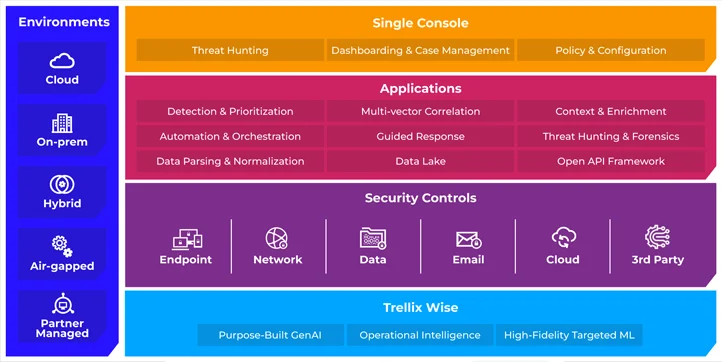
Overview: Trellix Data Loss Prevention is a suite of discovery and policy-enforcement capabilities designed to identify sensitive information and control how it is used or transferred across supported endpoints, networks, file repositories, email, web, removable devices, and cloud-integrated channels.
Key Features
- Trellix DLP Discover for networks and file repositories
- Sensitive-data discovery and classification
- Exact data matching and content fingerprinting
- OCR support for images and scanned documents where licensed
- Endpoint and network DLP
- Controls for copy-and-paste, printing, screen capture, removable media, email, and web uploads
- Rights-management and sensitivity-label integrations
- Incident management, reporting, and user coaching
Pros: Extensive DLP detection methods and granular controls over data in use, in motion, and at rest.
Cons: Deployment and policy tuning can be operationally demanding. Deep identity-based effective-permission analysis, access certification, and file-system permission remediation are not its primary focus.
Best For: Enterprises that need granular endpoint and network DLP with data discovery and policy-based control over sensitive-data movement.
9. Spirion Sensitive Data Platform (Acruired by archTIS)
Overview: Spirion Sensitive Data Platform helps organizations discover, classify, remediate, and report on sensitive structured and unstructured data across supported on-premises and cloud locations. It emphasizes privacy, data governance, persistent classification, and sensitive-data footprint reduction.
Key Features
- Discovery of structured and unstructured sensitive data
- Coverage for supported file repositories, databases, email systems, cloud repositories, and endpoints
- Persistent data classification
- Data-risk assessment and reporting
- Automated remediation workflows and playbooks
- Remediation logic based on metadata, location, dates, and access-control-list attributes
- Privacy and data-subject-request workflow support
Pros: Strong focus on sensitive-data discovery, privacy, classification, and remediation across diverse storage locations.
Cons: It is less focused on continuous infrastructure auditing, deep identity-threat detection, and behavioral monitoring than platforms centered on access governance and user activity.
Best For: Privacy- and compliance-driven organizations that need to discover, classify, reduce, and remediate sensitive-data exposure across on-premises and cloud repositories.
10. Fortra DLP (formerly Digital Guardian)
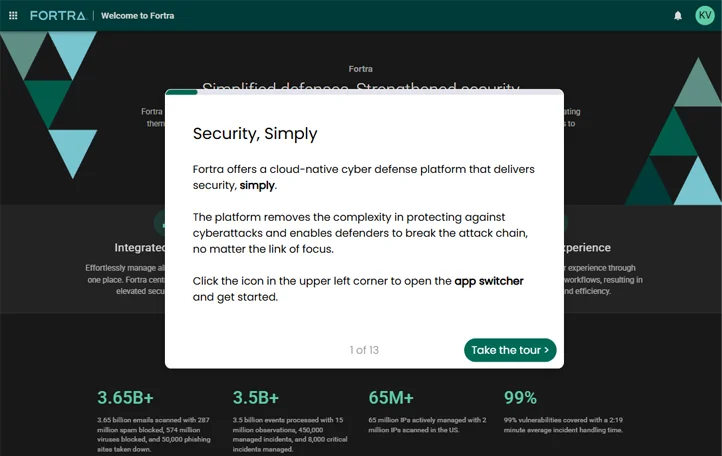
Overview: Fortra DLP, formerly Digital Guardian, provides data discovery, monitoring, and policy enforcement across supported endpoints, networks, cloud services, SaaS applications, servers, shares, and databases. It focuses on preventing unauthorized data use and exfiltration.
Key Features
- Endpoint DLP and user/data activity monitoring
- Network DLP for email, web, and other network channels
- Data-at-rest discovery across supported servers, shares, and databases
- Content inspection for structured and unstructured files
- Policy actions including monitoring, blocking, encryption, quarantine, rerouting, and user justification
- Protection for devices inside and outside the corporate network
- Cloud, SaaS, analytics, and incident-management capabilities
Pros: Strong endpoint visibility and granular enforcement, supplemented by network, cloud, and data-discovery capabilities.
Cons: Policy design and tuning may require significant operational effort. Deep effective-permission analysis, access reviews, and file-system permission remediation are not its primary functions.
Best For: Organizations protecting intellectual property and regulated data that require endpoint-centric DLP supported by network, cloud, and data-discovery controls.
How to Choose the Best Data Security Platform
Below are the factors to look into when selecting the right data security platform that adequately responds to the company’s individual risks and at the same time smoothly integrates with the existing IT environment.
1. Comprehensive Data Discovery and Classification
Search for a platform that identifies data and categorizes it through scanning each data silo where the actual unstructured data resides.Classification accuracy should be tested using organizational data. Platforms may combine rules, exact data matching, fingerprinting, OCR, contextual analysis, and machine-learning-assisted classification, resulting in less time spent filtering through non-threatening files.
2. Permission and Access Visibility
The best platforms can not only demonstrate effective permissions rather than those that are merely assigned but also identify rights, but also, they can identify rights that are too broad, that are unused, which will allow the access rights to be adjusted before any breach happens.
3. Threat Detection and User Activity Monitoring
Look for platforms that are good at setting up behavioral baselines very quickly, and evaluate configurable response options, including alerting, blocking, quarantine, permission remediation, or administrator-approved workflows
4. Hybrid & Cloud Coverage
Check that the platform can handle the exact combination of file servers, NAS devices, SharePoint, OneDrive, Teams, and cloud storage that is used in the organization. Even, search out the extent of monitoring each data source undergoes.
5. Compliance and Reporting
The reports generated from pre-built templates and audit-ready evidence save significant time compared to creating them manually in each audit cycle.
How Lepide Helps Protect Unstructured Data
Lepide Data Security Platform protects unstructured data by combining automated discovery, real-time change auditing, and access governance into a single tool. The platform reviews files on supported on-premises file systems and Microsoft cloud repositories to discover the existence of confidential documents, identify users and groups with excessive or unnecessary effective access, and spot suspicious behaviour.
The platform provides a unified and practical approach to handling complex data visibility changes, which includes:
- Sensitive Data Discovery and Classification: It automatically analyzes files on creation or at a scheduled time to detect the existence of confidential data like PII, financial documents, and intellectual property.
- Access Governance: This feature keeps track of who has access to the sensitive folders and ensures adherence to the principle of least privilege.
- Compliance Reporting: Provides audit trails and reports that can support evidence collection for requirements such as GDPR and HIPAA.
- Risk Detection and Alerting: Detects deviations in user behavior by using auditing, risk analysis, and configurable alerts to catch things like bulk file deletion, unusual access patterns, bulk file modifications, mass deletions, or other supported and configured risk indicators or signs of a ransomware attack.
Lepide offers a practical, fast-to-deploy solution for organizations that want to discover protected data, manage permissions, monitor activities and generate regulatory reports while saving on costs. This affordable solution can be implemented very quickly.
Frequently Asked Questions (FAQs)
A platform that discovers and classifies sensitive data, analyzes who can access it, monitors user activity, and detects threats from a centralized console spanning multiple repositories.
Unstructured data is the major part of a company’s data and it is harder to inventory than structured databases. Without dedicated visibility, sensitive files can sit exposed until a breach or audit brings them to light.
The features include accurate discovery and classification, effective permission analysis, behavioral threat detection, broad on-premises and cloud-storage coverage, and compliance-ready reporting.
Yes, a data security platform includes pre-built reports mapped to regulations like GDPR, HIPAA, and PCI DSS, plus audit trails documenting where sensitive data lives and who accessed it.
The best data security platform for protecting unstructured data depends on your environment. Varonis is suited for large enterprises focused on unstructured data, Microsoft Purview for Microsoft-centric organizations, IBM Guardium for enterprise data discovery, monitoring, and database security, and Lepide for sensitive-data discovery, permission analysis, auditing, and remediation across supported Microsoft-centric hybrid environments, with strong permission analysis and remediation.
Conclusion
Unstructured data remains one of the biggest security challenges organizations face, simply because there’s so much of it and it is so easy for permissions to drift out of control. Protecting unstructured data requires organizations to know where sensitive information resides, who can access it, and how it is being used. The best platform should provide the required capabilities across the organization’s supported on-premises and cloud repositories.
As data continues to spread across file servers, SaaS applications, and cloud storage, centralized visibility becomes increasingly important. Ultimately, organizations should choose a platform that aligns with their data environment, security priorities, scalability needs and budget.