Last Updated on September 29, 2026 by Satyendra
If you are still running Varonis in a self-hosted deployment and have not migrated to SaaS, you now need to decide whether to migrate or evaluate alternatives. Varonis has announced the end-of-life of its legacy self-hosted product by December 31, 2026, and is moving its platform strategy to SaaS.
Think of it like using software installed and managed on your own servers, then being told that the vendor will no longer support that version and that future capabilities will be available through its cloud service instead. You can migrate to the cloud service or evaluate another vendor that still supports your preferred deployment model.
This guide will explain what moving to Varonis SaaS means, whether it could work for you, and what alternatives you could look into to determine if Lepide is the best option.
What Does the Move to Varonis SaaS Mean for You?
Moving to Varonis SaaS means transitioning data security operations to a vendor-managed cloud platform, which can change how the platform is deployed, maintained, and managed, and may require obtaining approval from risk management, compliance, and architecture groups that may not be comfortable relinquishing control.
Some organizations are satisfied with this trade-off. Other organizations use this moment, when they are forced to migrate, to question whether Varonis is still their best option or whether the modern landscape has passed them by.
That is precisely the step that will be taken: a clear-eyed look at when a renewal is justified, when it is not, what a true competitor should have to offer, and how to determine this on your own rather than letting the deadline force the choice onto you.
When Does Considering Varonis Make Sense?
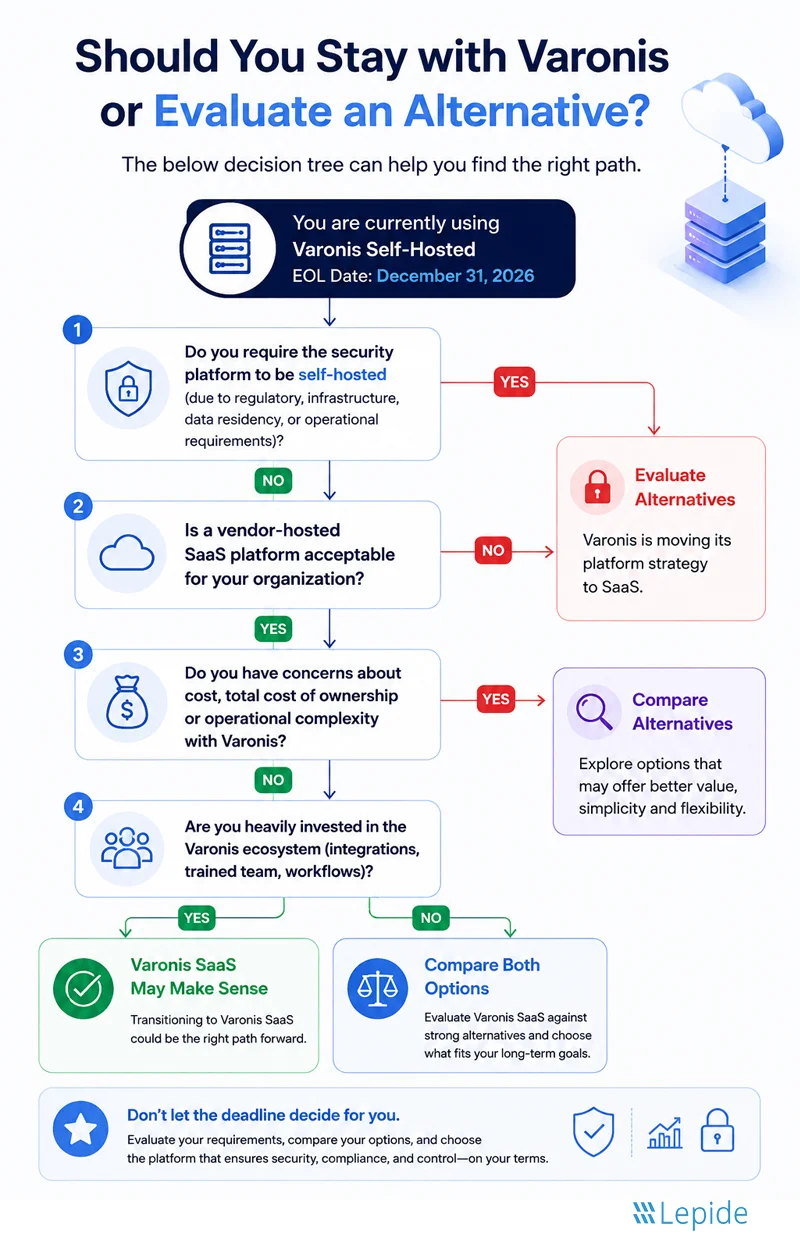
Keeping Varonis and transitioning to its SaaS model could be a good decision in several situations:
- Already Cloud-First: If your organization has already made the move from on-premises systems and is already working in Microsoft 365, storing data in the cloud, and using SaaS solutions, a cloud-based DSPM will naturally integrate into this environment.
- Invested in Varonis Ecosystem: The integration process is already established, with trained employees and workflows based on Varonis. If these investments are extensive and recent, migration can be cheaper than replacement.
- Fully Vendor-Hosted Model: Organizations whose security, regulatory, or data-residency requirements allow a vendor-managed SaaS platform may find the transition easier to accommodate.
- No Self-Hosted Platform Requirement: Organizations that do not require the Varonis platform to be self-hosted may find the transition to SaaS easier to accommodate.
If these circumstances apply, renewing and transitioning to Varonis SaaS may be a reasonable option.
When Should You Consider Replacing Varonis?
For Varonis customers, though, the end-of-life announcement may force them to look elsewhere. It’s worth seriously evaluating alternatives if:
- Need for Self-Hosted Deployment: Varonis has announced the end-of-life of its legacy self-hosted product, with new platform capabilities moving to its SaaS platform. Organizations that require the security platform itself to remain self-hosted because of regulatory, infrastructure, data-residency, or operational requirements may therefore need to evaluate alternatives.
- Cost is a Bigger Issue: Moving from an on-premises deployment to SaaS doesn’t come without unexpected costs that often appear in the transition to the new pricing model. Hence, if Varonis has already been an expensive solution, it’s a good time to start looking for alternatives.
- Complex or Resource-Heavy to Run: If the organization is experiencing deployment, configuration, tuning, or ongoing operational challenges with its current Varonis environment, the transition deadline can be an opportunity to reassess the platform.
- Concerned about Vendor Lock-in or Execution Risk: The move away from the legacy self-hosted product may create uncertainty for organizations that require long-term control over their deployment model, particularly existing customers who are using on-premises versions of the product. Thus, this forced migration might be a good opportunity to consider whether you really want to rely heavily on a single provider.
- Long-Term Deployment Flexibility: Even if you are comfortable with SaaS today, evaluating a vendor that continues to support the deployment models required by your organization can preserve flexibility for future infrastructure or compliance requirements.
If you can relate to any of the reasons provided above, use this deadline to your advantage rather than seeing it as an obligation.
What Should You Look for in an Alternative?
Not every “Varonis alternative” is a like-for-like replacement. As the vendors are evaluated, look for the following:
- Deployment Flexibility: Does the platform genuinely support self-hosted, hybrid, and SaaS deployment models, with continued engineering investment behind each, or could a currently supported deployment model eventually face the same fate as Varonis’s legacy self-hosted product?
- Real-Time Visibility and Response: You should pay attention to continuous auditing and monitoring capabilities and a fast response to risky behavior, as opposed to just periodic scans.
- Ease of Deployment and Use: Using a system that requires a couple of months of work on configurations and a dedicated specialist to manage it greatly diminishes the effectiveness of the security it offers. What matters is time-to-value.
- Total Cost of Ownership: Calculate not only the subscription cost but also the expenses related to licensing and infrastructure.
- Compliance Support: Built-in templates and reporting for standards like GDPR, HIPAA, PCI DSS, and SOX save significant time during audits.
- Migration Support: A vendor that offers a structured migration path, including the ability to validate the replacement alongside your existing tool before cutover, can reduce migration risk.
- Readiness for Microsoft 365 and AI: As more organizations roll out Copilot and expand their Microsoft 365 footprint, visibility into who can access sensitive data across SharePoint, OneDrive, and Teams is becoming an important part of file server and Active Directory auditing.
Look Beyond Data Discovery: Evaluate Identity and Access Visibility
A Varonis alternative should not be evaluated only on how it discovers and classifies sensitive information. Organizations should evaluate whether the platform can connect that information to the identities and permissions that expose it.
Lepide’s Perspective: Data exposure doesn’t happen by itself. Access is granted by identity; permissions enable access, with permission changes helping to expose data over time. A meaningful comparison of security solutions must therefore assess whether a platform is able to provide visibility across identity, permissions, and data together, rather than treating them as separate security problems.
Renew, Migrate or Replace: How to Decide?
The answer to this varies among different users based on their infrastructure, risk tolerance, and budget. A practical way to work through it is to consider the following:
- Map Deployment Requirements: Knowing whether you require a self-hosted, hybrid, or SaaS deployment model is crucial, as this can significantly affect the options available to you.
- Calculate the Real Cost: Moving from a self-hosted Varonis deployment to SaaS can involve migration, implementation, and other associated costs. Get concrete pricing and implementation estimates before deciding.
- Involve Compliance and Risk Early: If a vendor-managed, cloud-secured security solution is needed, you may require sign-offs from relevant departments that have not yet been consulted. Make sure you involve these stakeholders well ahead of time and not just the week before your deadline.
- Run a Proof of Concept: Regardless of what option you prefer, it is best to test the platform on your real data environment instead of relying on vendor demos.
- Build in a Buffer: With the December 31, 2026 cutoff approaching, don’t wait until the last quarter to start migration or replacement work. The rollout of data security solutions very often takes longer than planned.
Why Lepide is the Best Alternative to Varonis
Most organizations moving away from Varonis are not doing so as part of some trend- they are instead motivated by issues related to growing costs and increasing complexity. In fact, this is the situation Lepide consistently observes and, addresses through the following:
- Deployment Flexibility: Lepide supports organizations with deployment options including on-premises, hybrid, and cloud environments, making such a migration process unnecessary.
- One Unified, AI-Powered Platform: Lepide consolidates auditing, permission visibility, and data security capabilities in a single interface across Active Directory, Windows file servers, Microsoft 365 (including SharePoint Online, OneDrive, and Teams), and supported cloud environments.
- Built for Active Directory and Permission Visibility: Lepide tracks privileged group changes, permission changes, failed access attempts, and suspicious behavior in AD, and helps identify excessive access and stale permissions that can increase data security risk.
- Ready for Microsoft 365 and Copilot Rollouts: When expanding Microsoft 365 or enabling Copilot, Lepide can help organizations assess who has access to sensitive data and identify permission-related exposure that may affect AI-assisted access to organizational data.
- Built-In Audit and Compliance Reporting: Pre-built reports support frameworks like NIST, GDPR, HIPAA, and PCI DSS, as well as least-privilege and user access review processes, reducing the time-consuming manual evidence gathering required before an audit.
The end-of-life of Varonis’ legacy self-hosted product does not necessarily mean you have to adopt Varonis SaaS. It’s a great opportunity to weigh the pros and cons of various solutions before making the ultimate choice of provider. If you feel ready to explore, Lepide offers a data security platform built for flexibility, speed, and lower total cost, without locking you into one vendor’s roadmap.
Considering your next move after Varonis self-hosted EOL? Schedule a demo to see how Lepide can support your security requirements while giving you the deployment flexibility your organization needs.