


Last Updated on September 22, 2026 by Satyendra
CJIS compliance applies to law enforcement agencies, contract organizations, and any other organization that accesses, processes, stores, or transmits CJI.
This guide breaks down what CJIS compliance entails, the challenges of maintaining it in a hybrid IT architecture, and how to prepare for a CJIS audit using a specific process.
What is CJIS Compliance?
CJIS is the FBI’s Criminal Justice Information Services (CJIS) Security Policy and is aimed at protecting Criminal Justice Information (CJI). This includes information collected, stored, disseminated, or processed by criminal justice agencies for authorized criminal justice purposes, including certain biometric, identity-history, and criminal-history information.
Compliance means meeting CJIS security requirements, while audit readiness means having documented controls, ongoing monitoring, and evidence to demonstrate compliance during an assessment. An organization may have implemented required controls but still receive audit findings if it cannot provide sufficient evidence that those controls are implemented and operating as required.
What Organizations Need to Know About CJIS Security Policy (V6.1)
Organizations should align their controls with the current version of the CJIS Security Policy and any applicable state or agency-specific requirements. As the CJIS Security Policy is updated, organizations should review changes to ensure their security, identity, access, and other relevant controls remain aligned with current requirements.
This makes periodic review essential. Organizations must review their policies and controls to ensure that they align with the current set of requirements and not the old set of guidelines. This may happen inadvertently; however, it may lead to gaps in compliance until an audit uncovers them.
Key CJIS Compliance Requirements
CJIS compliance requires organizations to implement security controls across multiple areas to protect Criminal Justice Information (CJI). These requirements can be grouped into five core areas that form the foundation of CJIS compliance and audit readiness.
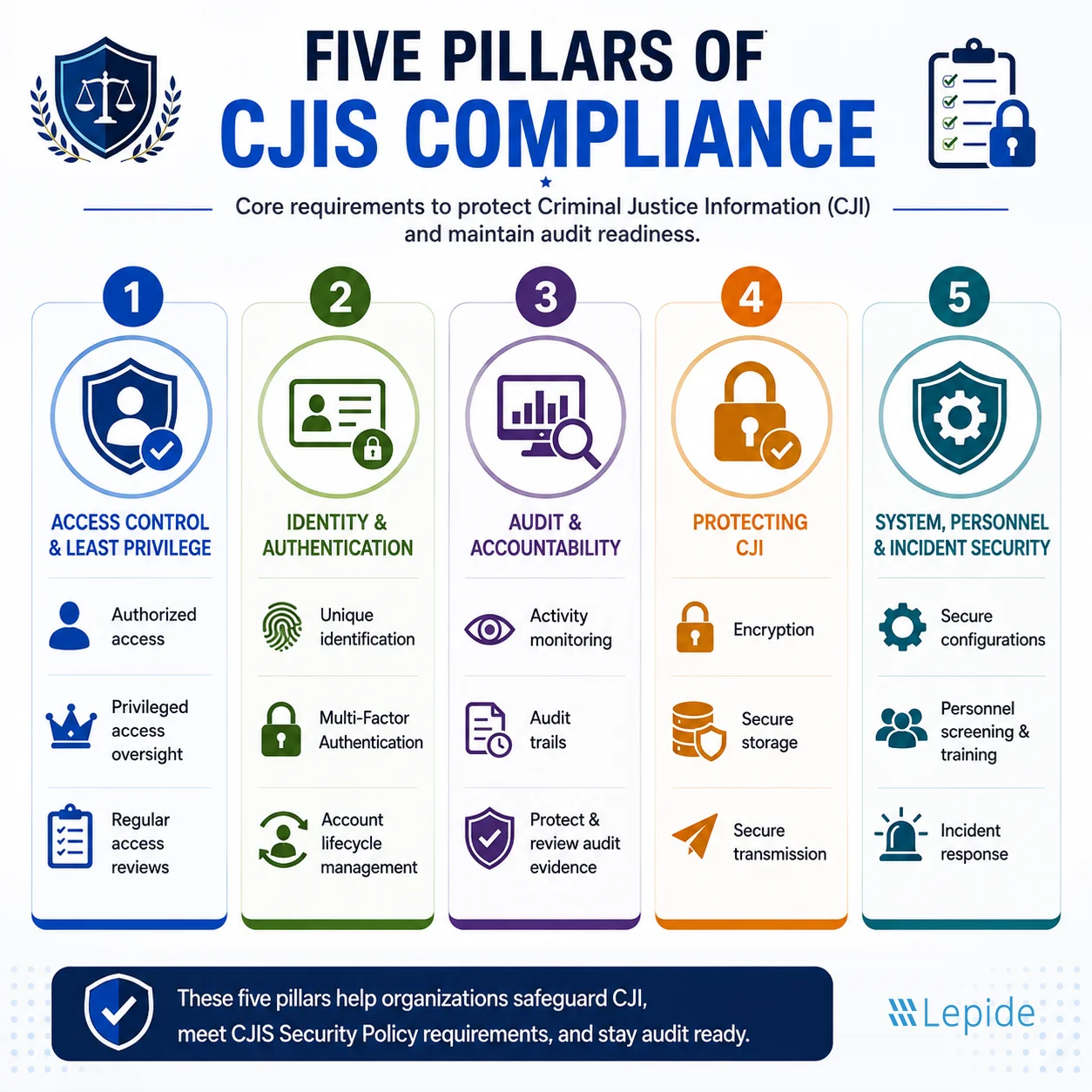
| CJIS Compliance Requirement | Key Controls and Considerations |
|---|---|
| Access Control and Least Privilege |
|
| Identity and Authentication |
|
| Audit and Accountability |
|
| Protecting CJI |
|
| System, Personnel, and Incident Security |
|
CJIS Compliance Challenges in Hybrid Environments
Meeting these requirements is much harder in the environments in which most companies work today. Fewer organizations can maintain a single self-contained system. Most organizations must maintain a combination of:
- Active Directory and Entra ID, often running in parallel as organizations move towards the cloud.
- File Servers and Microsoft 365, each with its own permission model.
- On-Premises and Cloud Systems, often managed separately with separate tools.
These elements produce the following recurring challenges:
- Fragmented Identities and Permissions: The same user has different paths to access rights in both on-premises and cloud platforms, making it difficult to get an overall perspective of “who can access what.”
- Inconsistent Monitoring: The activity logs can be spread across multiple platforms without any unified view.
- Difficulty Understanding Effective Access: Complex configurations like nested groups, inherited permissions, and role mappings make it difficult to identify actual access rights as opposed to just theoretical access rights.
- Third-Party and Cloud-Service Responsibilities: Shared responsibility models make it difficult to identify the actual controls owned by the organization and those provided by vendors.
Addressing this requires:
- Centralized visibility across on-premises and cloud systems.
- Consistent least-privilege controls and access oversight regardless of where data or identities live.
- Unified monitoring that doesn’t stop at the edge of one platform.
- Continuous permission oversight, rather than periodic, manual checks that go stale between reviews.
How to Prepare for a CJIS Audit
This is where preparation becomes implementation. A well-defined and repeatable process ensures that audits become much less disruptive.
- Define CJI Scope: Begin by identifying where CJI is, as well as the users, systems, and third parties interacting with the data. You cannot secure what you have not mapped.
- Map Requirements to Controls: Build a clear line from policy to practice using a simple structure. This makes it easy to see, for any given CJIS requirement, exactly which control satisfies it, who is responsible, and what evidence demonstrates it.
Requirement → Control → Owner → Evidence - Review Access and Privileges: Review permissions to identify excessive access, privileged accounts, inactive accounts, unnecessary vendor access, and risks created by inherited or nested permissions.
- Validate Monitoring: Confirm that relevant identity, administrative, permission, and CJI-related activity is visible, not just theoretically logged somewhere. This is a coverage check, not a detailed-log event inventory.
- Gather Audit Evidence: Centralize all the documentation that will be requested by an auditor during the audit, including policies, access reviews, permissions, audit logs, incidents, remediations, and training. Having documentation distributed across various systems and teams is one of the most frequent causes of audit delays.
- Remediate Gaps: After identifying gaps, assign ownership and document corrective actions. Without evidence of remediation, it may be difficult to demonstrate to an auditor that the issue was addressed.
- Conduct an Internal Readiness Review: Before the actual audit, test whether your team can quickly and confidently answer the questions an auditor is likely to ask. If the answers take days to compile, the readiness work isn’t finished yet.
CJIS Audit Readiness Checklist and Common Gaps
CJIS Audit Readiness Checklist
Use the following checklist to assess whether the key controls, processes, and evidence needed to demonstrate CJIS compliance are in place and ready for review.
- CJI Locations Identified: Know exactly where Criminal Justice Information (CJI) is stored, processed, or transmitted so no sensitive data falls outside your security controls.
- Systems in Scope Documented: Maintain an inventory of all applications, servers, databases, and devices that handle or can access CJI.
- Users with Access Identified: Document everyone who can access CJI, including employees, administrators, contractors, and other authorized users.
- Privileged Access Reviewed: Regularly review administrator and other elevated accounts to ensure privileged access is necessary and appropriately controlled.
- Excessive Permissions Addressed: Remove unnecessary access rights to enforce least privilege and reduce the risk of unauthorized CJI exposure
- MFA Controls Validated: Confirm that multi-factor authentication is implemented and operating in accordance with applicable CJIS Security Policy authentication requirements.
- Monitoring Coverage Confirmed: Ensure relevant systems, user activity, access events, and security changes are monitored to detect suspicious behavior.
- Audit Evidence Available: Keep logs, reports, access reviews, and other evidence organized and readily available to demonstrate compliance during an audit.
- Hybrid Systems Included: Include both on-premises and cloud environments in your compliance scope to avoid visibility and monitoring gaps
- Current Policies: Review and update CJIS-related security policies regularly to ensure they reflect current systems, risks, and requirements.
- Training Documented: Maintain records showing that relevant personnel have completed required security and CJIS awareness training
- Incident-Response Procedures Current: Ensure incident-response plans are up to date, tested, and clearly define how security incidents involving CJI will be handled.
- Third-Party Responsibilities Documented: Clearly define and document the security and compliance responsibilities of vendors or third parties that handle or access CJI.
- Remediation Evidence Retained: Keep records showing how identified security or compliance issues were investigated, corrected, and verified.
Common CJIS Audit Readiness Gaps
Even when required security controls are in place, gaps in access, monitoring, documentation, and evidence can affect audit readiness. The following are some common issues organizations should look for and address before an audit.
- Excessive or Outdated Access: Users often retain permissions they no longer need after changing roles, increasing the risk of unnecessary CJI exposure
- Dormant Privileged Accounts: Unused administrator accounts may remain active and become easy targets for attackers if they are not regularly identified and removed.
- Incomplete Monitoring: Organizations may collect logs from some systems but lack sufficient visibility into critical CJI access or security events.
- Hybrid-Environment Blind Spots: Separate on-premises and cloud monitoring can create gaps that prevent organizations from seeing the complete security picture.
- Missing Access-Review Evidence: Access reviews may be performed, but poor recordkeeping makes it difficult to prove they occurred during an audit.
- Poor Documentation: Missing or outdated policies, system inventories, and security procedures can make compliance difficult to demonstrate.
- CJI Stored in Unexpected Locations: Sensitive information can spread to unmanaged shares, endpoints, cloud applications, or other locations outside established controls.
- Preparing Only When an Audit Approaches: Treating compliance as a periodic exercise instead of a continuous process often leaves gaps undiscovered until the audit is nearby.
How Lepide Helps With CJIS Compliance and Audit Readiness
With Lepide, it is easier for IT and security professionals to monitor user activity within Active Directory, Microsoft 365, and file servers. This helps reduce visibility gaps and gives IT and security teams greater insight into user activity across supported environments.
- Gain Visibility into Sensitive Data and Access: Help identify sensitive data that may contain CJI across supported environments and understand who can access it.
- Reduce Excessive Access: Evaluate effective permissions, including access granted through group memberships and nested groups.
- Monitor User and Permission Activity: Monitor user activity across supported Active Directory, Microsoft Entra ID, file systems, and Microsoft 365 environments.
- Detect Risky Changes: Receive alerts for suspicious permission changes and other potentially risky activity involving sensitive data.
- Maintain Audit-Ready Evidence: Use reports and historical activity records to help support the evidence required for CJIS audits and compliance reviews.
- Support Hybrid Environments: Gain centralized visibility across supported on-premises and Microsoft cloud environments to help reduce blind spots across hybrid environments.
Schedule a demo with one of our experts to see how Lepide can help strengthen CJI access visibility, monitor critical activity, and support CJIS compliance and audit readiness.
Frequently Asked Questions
Yes. Applicable CJIS requirements are mandatory for criminal justice agencies and other authorized entities that access, process, store, or transmit CJI under applicable CJIS agreements and policies. This requirement applies only as specified in the relevant CJIS agreements and policies.
Non-compliance can result in audit findings and corrective action requirements. Depending on the nature and severity of the violation, an organization may face sanctions, restrictions, or loss of access to CJIS systems or Criminal Justice Information. Organizations may also face additional consequences under applicable laws, regulations, contracts, or state-level requirements.
CJIS audit-log retention requirements should be determined using the applicable CJIS Security Policy and relevant agency or state requirements. Organizations should also retain logs for as long as needed to support security investigations and audits, meet legal obligations, and satisfy other applicable requirements.