Last Updated on August 24, 2026 by Satyendra
Producing audit-ready reports for GDPR compliance involves knowing who has accessed personal data, what changes were made and when, and making this information available to relevant parties available to others. GDPR requires organizations to demonstrate accountability and implement appropriate technical and organizational measures to protect personal data. Audit-ready evidence can help demonstrate these measures and support compliance reviews or investigations.
This process comes down to four steps: identify relevant activity, collect audit data, organize the evidence, and generate clear reports.
What Should GDPR Audit Reports Demonstrate?
While GDPR does not prescribe a specific audit-report format, organizations should maintain evidence that helps demonstrate accountability, appropriate security measures, and compliance with their obligations.
- Who Accessed Personal Data and When: A clear record of access events tied to individual users.
- Changes Made to Files, Folders, Databases, or Other Systems that store or process personal data.
- Changes to User Accounts, Groups, and Permissions, since access rights directly affect who can reach sensitive information.
- Activity Performed by Privileged Users, such as administrators, who have the broadest access and the greatest potential impact.
- Evidence of Appropriate Access Controls, confirming that access controls were in place, and only legitimate access was granted to the data.
- Security-Related events that can put personal data at risk, such as failed login attempts, changes to access rights, or unusual access behavior
- Evidence of Suspicious or Unauthorized Activity used to investigate incidents and demonstrate the organization’s readiness to respond to security incidents.
- Records That Support Broader Accountability and Security Obligations, demonstrating that the organization is accountable for activities related to its responsibilities.
Key Takeaways: GDPR does not require a single standard document known as a “GDPR audit report”. What is critical is whether the evidence supplied by the organization is relevant, accurate, and sufficient to demonstrate that personal data has been processed properly.
What Should an Audit-Ready GDPR Report Include?
An audit-ready GDPR report should give enough detail to answer the core questions any reviewer will ask: who did what, when, and what changed as a result.
| Activity | What It shows |
|---|---|
| User Identity | Who performed the action |
| Audit Information | What it should show |
| Data Access | Affected Resource – the file, folder, database object, account, or other resource involved. |
| Type of activity | Access, modification, creation, deletion, group change, or permission change |
| Timestamp | Exactly when the activity occurred |
| Source/location | Where the action originated from (device, IP address, or application) |
| Authentication events | Successful and failed login attempts and other relevant authentication activity |
A report built around these elements gives auditors and investigations a complete, contextual picture rather than a raw, disconnected list of events. The purpose isn’t just to log activity; it’s to make that activity understandable
GDPR Audit Readiness Starts Before Data Is Accessed
GDPR does not prescribe a universal requirement to log every instance in which a person accesses, modifies, or deletes personal data. However, organizations should maintain appropriate evidence and logging based on their processing activities, risks, and security obligations.
Organizations should connect data activity with identity and permission changes. While the fact that a person has accessed personal data is important, knowing whether the access occurred due to a permission or group change gives invaluable insight into the appropriateness of the action.
How to Collect Audit-Ready Data for GDPR Reporting
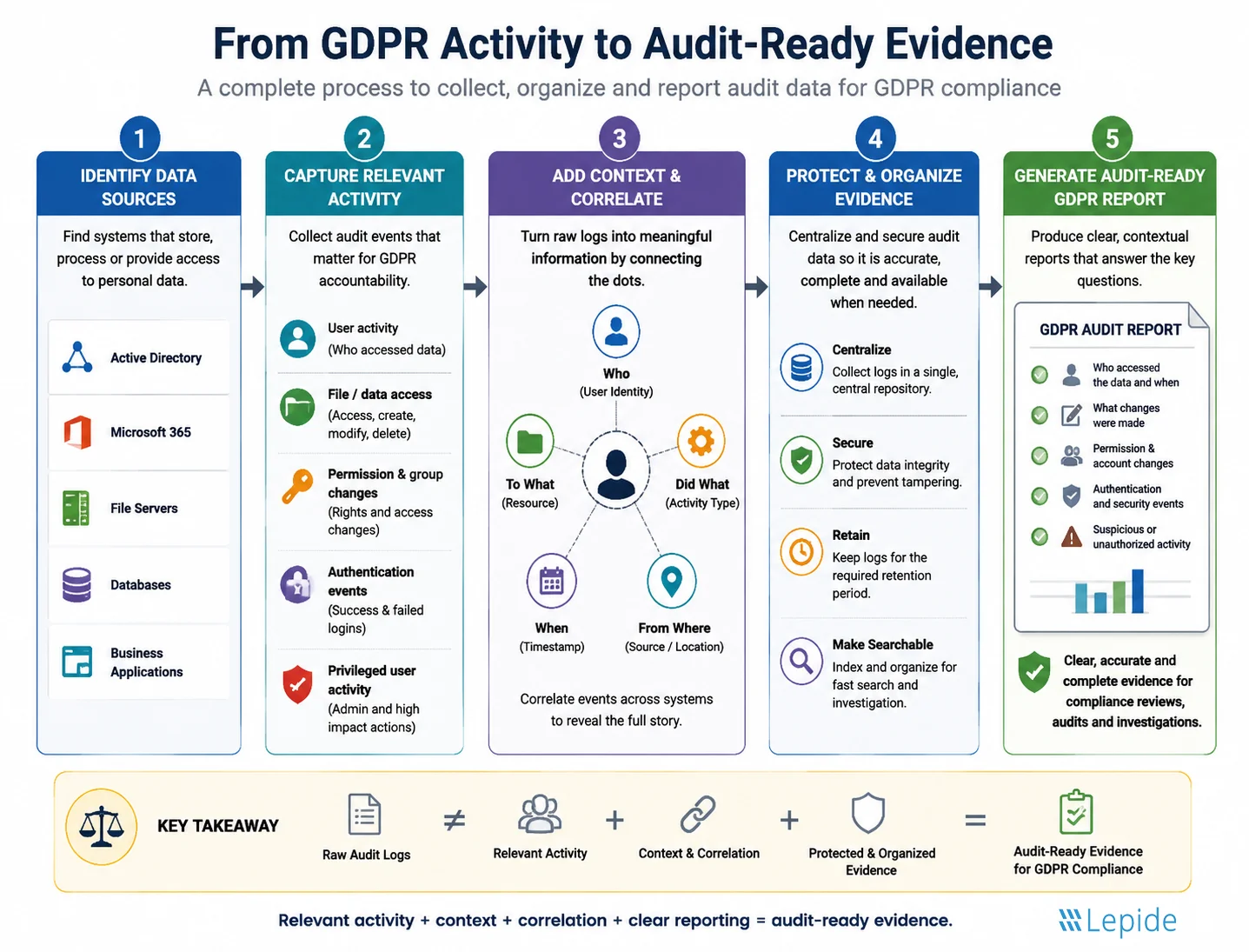
Collecting audit-ready data starts with identifying where personal data is stored, processed, and accessed, and determining which activities need to be recorded. Organizations should then collect audit events from those systems with context needed for compliance review and investigation.
- Identify Systems Handling Personal Data: Determine which systems store, process, or provide access to personal data. These may include Active Directory, Microsoft 365, file servers, databases, and other business applications
- Configure Relevant Auditing: Enable and configure appropriate auditing on relevant systems. The collected events should represent the environment, processing activities, security needs and risks of that organization.
- Collect Relevant Audit Events: Capture relevant activity such as authentication events, access to personal data, file or data changes, account and group changes, permission changes, and privileged-user activity.
- Capture Adequate Context: Audit log entries must provide adequate context to interpret event information, including the nature of the event and other relevant details.
- Centralize and Correlate Audit Data: Where appropriate, consolidate audit information from multiple systems so related events can be searched and correlated. Linking events across identity management, permission management, authentication, and data-access systems, and data-access systems can help provide more context in the audit and investigation
- Protect and Retain Audit Evidence: Safeguard collected audit records against unauthorized access, alteration, or deletion, and retain them according to applicable legal requirements and organizational retention policies.
Key Takeaways: Auditable data is not merely raw logs. Relevant events should be gathered with context, securely stored, and organized as accessible evidence for GDPR compliance reviews and security investigations.
Challenges in Producing Audit-Ready GDPR Reports
Even when organizations have logging in place, it does not necessarily mean they can readily use that information for audit purposes. Some of the most common challenges include the following:
- Fragmented Silos: Personal data and audit evidence can be spread across multiple systems and departments, making it difficult to build a complete and consistent view of processing activity and security controls.
- High Volumes of Raw Events: Large volumes of activity data make it difficult to identify the events that are relevant to GDPR compliance.
- Complex Native Logs: Native logs can be difficult to interpret without proper technical knowledge, leading to delays in investigations.
- Manual Report Compilation: Manually collecting and consolidating data from multiple sources is time-consuming and prone to errors.
- Cross-System Correlation: Correlating user activity across different systems can be challenging because of differences in identities, timestamps, log formats, and event structures.
- Limited Access to Historical Evidence: Organizations may struggle to quickly retrieve historical activity and evidence when auditors or compliance teams request it on short notice.
- Inconsistent Reporting Formats: Differences in reporting formats across systems can make compliance checks challenging for auditors.
Key Takeaways: Simply having audit logs is not the same as having audit-ready evidence. Logs need to be collected, correlated, and translated into a format that’s actually usable when it matters.
Best Practices for Maintaining Audit-Ready GDPR Reports
Maintaining audit-ready GDPR reports requires more than collecting logs. Organizations should establish consistent processes for identifying, monitoring, protecting, and reporting activity involving personal data. Below are the best practices:
- Identify Systems Containing Personal Data: Determine where personal and sensitive information is stored, accessed, and processed across the organization.
- Define Relevant Audit Events: Establish which access, modification, permission, account, and security events need to be monitored.
- Monitor Privileged Activity: Pay particular attention to administrators and other users with elevated access, as their actions can have a significant impact on sensitive data.
- Review Permissions Regularly: Periodically review user and group permissions to ensure individuals retain only the access required for their roles
- Centralize Audit Data Where Possible: Consolidate audit information from relevant systems to make it easier to search, correlate, investigate, and generate activity reports.
- Automate Recurring Reports: Schedule recurring compliance reports to reduce manual effort and ensure evidence is consistently available when required.
- Protect Audit Records: Protect audit records against unauthorized modification, deletion, or access, and retain them according to applicable retention requirements and organizational policies.
- Regularly Review Reporting Effectiveness: Test reports periodically to ensure they provide accurate, relevant, and timely evidence for GDPR compliance reviews and investigations.
How Lepide Helps Produce Audit-Ready GDPR Reports
The Lepide Data Security Platform enables security and compliance teams to centralize audit data from supported systems and generate reports that support GDPR auditing and accountability requirements.
Lepide enables teams to investigate suspicious activity through searchable audit trails and centralized visibility, generate scheduled reports, and receive real-time alerts for important changes or suspicious activity.
Overall, Lepide simplifies audit evidence gathering by centralizing relevant activity data, monitoring changes to users, groups, permissions, and files across supported environments, and providing reports that can support GDPR compliance and investigations.
Want to see how Lepide can help simplify GDPR auditing and reporting? Schedule a personalized demo to see how the Lepide Data Security Platform provides centralized visibility, searchable audit trails, real-time alerts, and reporting across your environment.
Frequently Asked Questions
An audit-ready report contains relevant information about who accessed personal data, what changes occurred, and when these actions took place. This data can be shown to auditors and regulatory authorities to provide evidence supporting the organization’s accountability and security obligations under GDPR.
To produce a GDPR audit-ready report, one must identify the user, identify when the action occurred, the resource involved, describe the nature of the action and explain what happened, and specify where the action came from.
GDPR does not prescribe a universal frequency for generating audit reports. Organizations can determine an appropriate reporting frequency based on their risk profile, processing activities, internal policies, and audit or investigation requirements. Some organizations opt to prepare audit reports at a predetermined frequency (weekly or monthly) and also prepare them as needed for investigations or regulatory compliance.
By centralizing audit data from relevant systems and using tools that support predefined report templates and scheduled report generation, organizations can reduce manual effort and ensure reports are consistently available.
Yes. File auditing can help organizations monitor access to and changes involving files that contain personal data. This can provide evidence supporting security, accountability, and investigation requirements under GDPR.