


Last Updated on May 11, 2026 by Ashok Kumar
Some Insider Risk Prevention and Monitoring Tools focus on behavior analytics and detection, others focus on evidence, case workflows, and preventing risky actions in real time. The best fit depends on what you need to catch and what you need to prove.
How to Choose the Best Insider Risk Management Tool for Your Business
Choosing the right insider risk management tool depends on what kind of risk you need to detect, investigate, and prevent. Some tools are better at behavior analytics, others at evidence collection, and others at data movement monitoring. The best choice is the one that gives your team the right signals without burying them in noise..
- Best for Behavior Analytics and Early Detection: If your priority is spotting risky activity before it becomes an incident, look for tools with strong User and Entity Behavior Analytics (UEBA). These platforms establish a baseline of normal user activity and flag unusual patterns such as odd login times, mass file access, or sudden privilege changes.
- Best for Investigation and Case Management: If your team needs to investigate incidents from alert to resolution, choose a platform with built-in case management. The best tools let analysts collect evidence, track findings, correlate events, and document actions in one place.
- Best for Identity and Authentication Visibility: If insider risk in your environment is heavily tied to identity misuse, focus on tools that monitor authentication events, Active Directory activity, privileged access changes, and login anomalies. Identity signals often provide the clearest early warning of suspicious behavior.
- Best for User Activity Monitoring and Audit Trails: If you need detailed visibility into what users actually did, choose a tool with strong audit trails and activity monitoring. Features like file access tracking, endpoint monitoring, session recording, and user timelines help teams reconstruct incidents and support compliance reviews.
- Best for Data Movement and Exfiltration Detection: If your biggest concern is sensitive data leaving the organization, prioritize tools that monitor file transfers, cloud uploads, mass downloads, and suspicious copying activity. Solutions that combine identity analytics with data monitoring usually provide the strongest protection against data loss.
Comparing the 20 Best Insider Risk Prevention and Monitoring Tools
| Tool Name | Best For | Deployment | Core Strength | Limitation |
|---|---|---|---|---|
| Lepide Data Security Platform | Hybrid AD environments | Cloud / On-prem / Hybrid | Real-time auditing + behavior analytics | Requires tuning for large environments |
| Microsoft Purview Insider Risk Management | Microsoft 365 ecosystems | Cloud | Native Microsoft identity and data signals | Limited outside the Microsoft stack |
| Microsoft Sentinel UEBA | Azure-centric SOC teams | Cloud | Scalable UEBA analytics | Requires centralized log ingestion |
| CrowdStrike Falcon Identity Protection | Identity + endpoint detection | Cloud / On-prem | Identity-endpoint correlation | Less data-centric monitoring |
| Splunk UEBA / Enterprise Security | Custom analytics environments | Cloud / On-prem | Powerful correlation and dashboards | Requires configuration |
| IBM QRadar UEBA | Large enterprise SOCs | On-prem / Hybrid | SIEM-integrated risk scoring | Depends on the QRadar ecosystem |
| Exabeam UEBA | Timeline-based investigations | Cloud / On-prem | Automated incident stories | Requires a mature SOC workflow |
| Securonix Insider Threat | High-volume enterprise monitoring | Cloud / On-prem | Advanced behavioral analytics | Platform complexity |
| Proofpoint Insider Threat Management | Investigation evidence collection | Cloud / On-prem | Endpoint session recording | Less broad analytics |
| DTEX Systems | Human-risk analytics | Cloud | Endpoint behavior telemetry | Narrower detection scope |
| Forcepoint Insider Threat | DLP + insider risk | Cloud / On-prem | Policy-driven prevention | DLP-heavy architecture |
| Gurucul Insider Risk Management | ML-driven risk scoring | Cloud / On-prem / Hybrid | Identity behavior analytics | Platform learning curve |
| Rapid7 InsightIDR | Fast UEBA deployment | Cloud | Built-in detections | Limited deep forensic evidence |
| Veriato Insider Risk Management | Employee activity recording | Cloud / On-prem | Detailed timelines and playback | Monitoring can be intrusive |
| Teramind Insider Risk Detection | Session monitoring | Cloud / On-prem | Screen recording and blocking | Heavy monitoring footprint |
| Code42 Incydr | Data exfiltration monitoring | Cloud | File movement visibility | Limited behavior analytics |
| Syteca | Privileged session monitoring | On-prem / Hybrid | Detailed privileged session capture | Less cloud-native |
| Quest ITDR | Active Directory environments | On-prem / Hybrid | Identity attack detection | Identity-focused scope |
| Varonis Insider Risk Management | Data exposure analysis | Cloud / On-prem | Permission and data activity analytics | Less endpoint visibility |
| Netwrix Insider Threat Detection | AD and file monitoring | On-prem / Hybrid | Identity and access auditing | Less behavioral automation |
20 Most Effective Insider Risk Prevention and Monitoring Tools
1. Lepide Data Security Platform
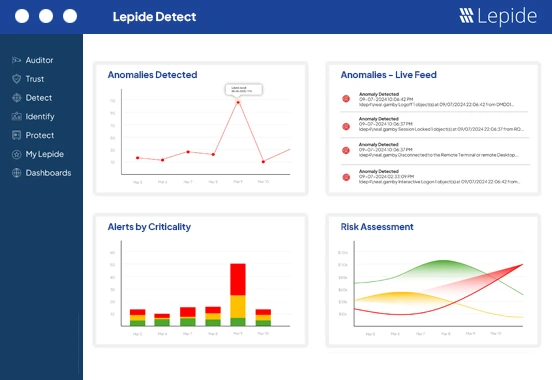
The Lepide Data Security Platform provides unified visibility into user activity, permissions, and sensitive data across hybrid environments. The platform monitors changes and access events across Active Directory, file servers, cloud platforms, and enterprise systems, allowing organizations to identify risky user behavior and potential insider incidents in real time.
Lepide combines user behavior analytics, data access auditing, and prebuilt insider risk models to detect suspicious activity patterns such as mass file access, privilege escalation, or unusual login behavior. By correlating identity activity with file system and system-level events, the platform helps security teams quickly understand who accessed what data, when the activity occurred, and whether the behavior deviates from normal patterns.
Key Features
- Detects risky insider activity using behavior analytics and predefined threat models
- Correlates Active Directory activity with file system and system events
- Provides real-time alerts for suspicious behavior such as unusual file access or privilege misuse
- Supports automated response actions including account suspension or permission removal
- Generates compliance-ready reports for audits and investigations
2. Microsoft Purview Insider Risk Management
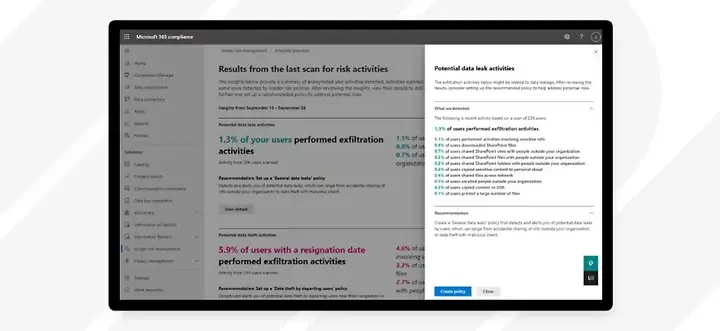
Microsoft Purview Insider Risk Management is designed to help organizations detect, investigate, and respond to insider risks across Microsoft 365 environments. The platform collects signals from Microsoft services such as Exchange, SharePoint, OneDrive, Teams, and Entra ID to identify potentially risky behavior involving sensitive data or corporate assets.
Purview uses built-in policy templates and machine learning models to detect activities such as data exfiltration, policy violations, or risky communication behavior. Security and compliance teams can create customized policies to monitor scenarios such as data theft by departing employees, accidental data exposure, or unauthorized sharing of sensitive files.
The solution also includes investigation workflows and case management capabilities that allow analysts to review alerts, analyze evidence, and collaborate on investigations while maintaining privacy controls designed to comply with regulatory requirements.
Key Features
- Preconfigured insider risk detection policies
- Integration with Microsoft 365 identity and content signals
- Built-in investigation and case management workflows
- Privacy controls to protect user identities during investigations
3. Microsoft Sentinel (UEBA)
Microsoft Sentinel provides user and entity behavior analytics as part of its cloud-native SIEM and security analytics platform. Sentinel collects and analyzes telemetry from identity providers, applications, endpoints, and infrastructure systems to detect anomalies and suspicious user behavior.
The platform builds behavioral baselines for users and entities, allowing it to identify deviations such as unusual login patterns, abnormal access activity, or suspicious account behavior. By correlating identity signals with other security telemetry, Sentinel helps analysts investigate insider incidents within the broader context of enterprise activity.
Sentinel also supports advanced threat hunting capabilities, automation workflows, and integration with Microsoft Defender products to streamline investigation and response processes.
Key Features
- UEBA models that baseline user and entity activity
- Risk scoring for suspicious behavior patterns
- Correlation across identity, endpoint, and network telemetry
- Advanced threat hunting tools and investigation notebooks
4. CrowdStrike Falcon Identity Protection
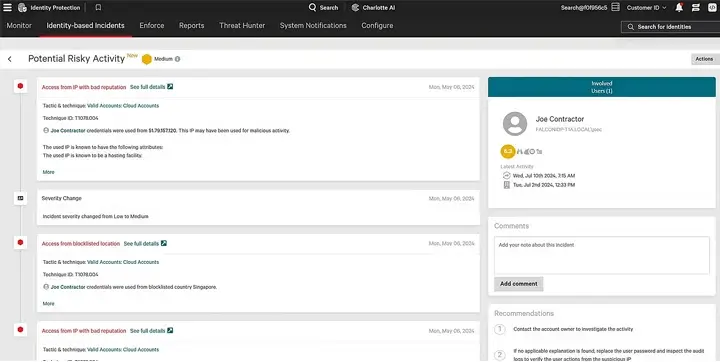
CrowdStrike Falcon Identity Protection focuses on detecting identity-based attacks and insider misuse by correlating authentication events with endpoint telemetry. The platform monitors identity activity across Active Directory and cloud identity providers to detect suspicious login attempts, credential abuse, and lateral movement.
By combining identity analytics with endpoint detection data, the platform provides deeper visibility into how accounts are being used and whether activity originates from compromised devices or unusual locations. This contextual approach helps reduce false positives and enables faster containment of identity-driven incidents.
Falcon Identity Protection also includes automated remediation capabilities, allowing organizations to enforce actions such as blocking access, forcing MFA, or isolating compromised accounts.
Key Features
- Identity risk scoring and anomaly detection
- Correlation between endpoint activity and authentication signals
- Detection of credential theft and lateral movement attempts
- Automated containment and response actions
5. Splunk UEBA / Splunk Enterprise Security
Splunk User and Entity Behavior Analytics extends the capabilities of Splunk Enterprise Security by applying machine learning to authentication logs, user activity events, and system telemetry. The platform builds behavioral baselines for users and systems and assigns risk scores when activity deviates from expected patterns.
Security analysts can use Splunk’s powerful search and correlation capabilities to investigate insider risk incidents by connecting identity events, application logs, and network activity across the environment. Custom dashboards and correlation searches allow organizations to tailor detection logic based on their specific infrastructure and security requirements.
Because Splunk can ingest data from virtually any source, it is particularly useful for large enterprises that require centralized analytics across diverse systems.
Key Features
- Machine learning-based anomaly detection
- Custom correlation searches and detection rules
- Risk scoring for users and entities
- Integrated incident investigation workflows
6. IBM QRadar UEBA
IBM QRadar UEBA extends the QRadar SIEM platform with advanced behavioral analytics that focus on identifying suspicious user activity and insider misuse. The system analyzes identity data, authentication logs, and network activity to build risk profiles for users and entities.
By continuously monitoring user behavior patterns, QRadar UEBA can detect anomalies such as unusual login activity, excessive file access, or unauthorized privilege escalation. These anomalies are incorporated into QRadar’s offense detection framework, allowing analysts to investigate incidents within the same workflow used for other security events.
The platform is commonly used in large enterprise SOC environments where insider risk detection must be integrated with broader threat monitoring operations.
Key Features
- Behavioral baselining for users and entities
- Risk scoring based on identity and activity signals
- Integration with QRadar SIEM offense workflows
- Scalable analytics for high-volume log environments
7. Exabeam UEBA
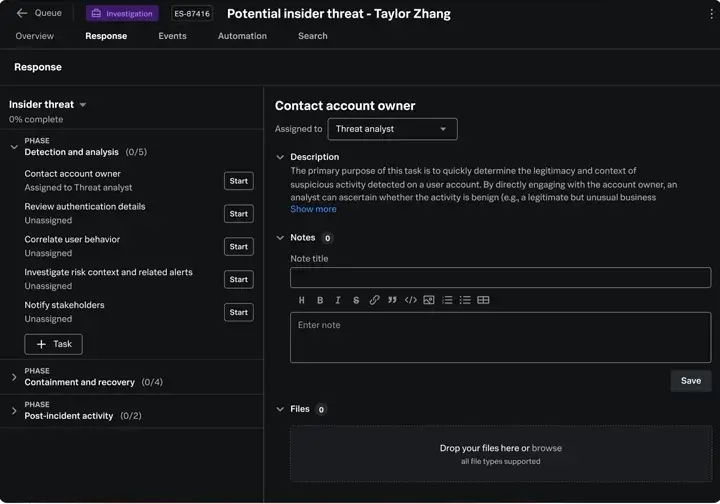
Exabeam UEBA focuses on behavioral analytics and timeline-based investigations that help security teams understand complex insider incidents. The platform collects identity and activity data from multiple sources and automatically builds timelines that reconstruct user behavior during an incident
By linking related events together, Exabeam helps analysts identify patterns such as credential misuse, abnormal access patterns, or suspicious data movement. Automated “incident stories” provide a structured view of events so investigators can quickly determine what happened and which actions require attention.
Key Features
- Timeline-based investigation workflows
- Behavior-based anomaly detection
- Automated incident story generation
- Risk scoring and alert prioritization
8. Securonix Insider Threat
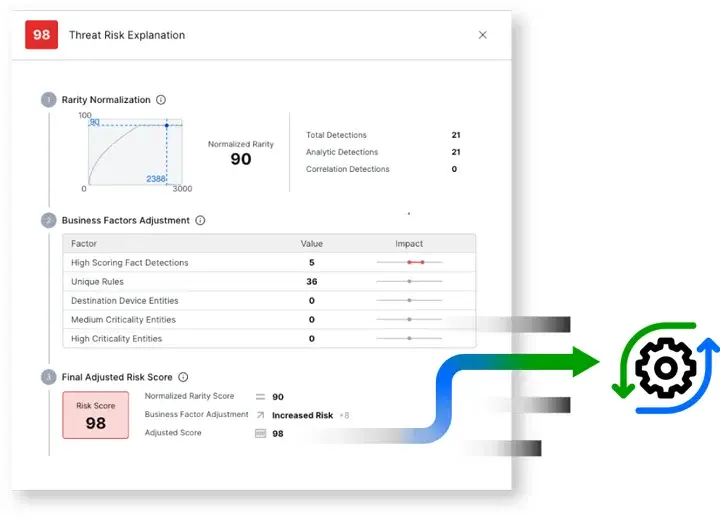
Securonix Insider Risk is part of the broader Securonix security analytics platform and uses machine learning and big-data analytics to detect abnormal user behavior across enterprise systems. The platform analyzes authentication events, application logs, endpoint telemetry, and data access activity to identify potential insider threats.
Securonix supports customizable threat models designed to detect scenarios such as privileged abuse, data exfiltration, and compromised accounts. Organizations with high log volumes often choose Securonix because of its ability to process large datasets and generate risk-based alerts.
Key Features
- Advanced UEBA analytics
- Predictive insider risk detection models
- Case management and investigation workflows
- Risk scoring for user behavior patterns
9. Proofpoint Insider Threat Management
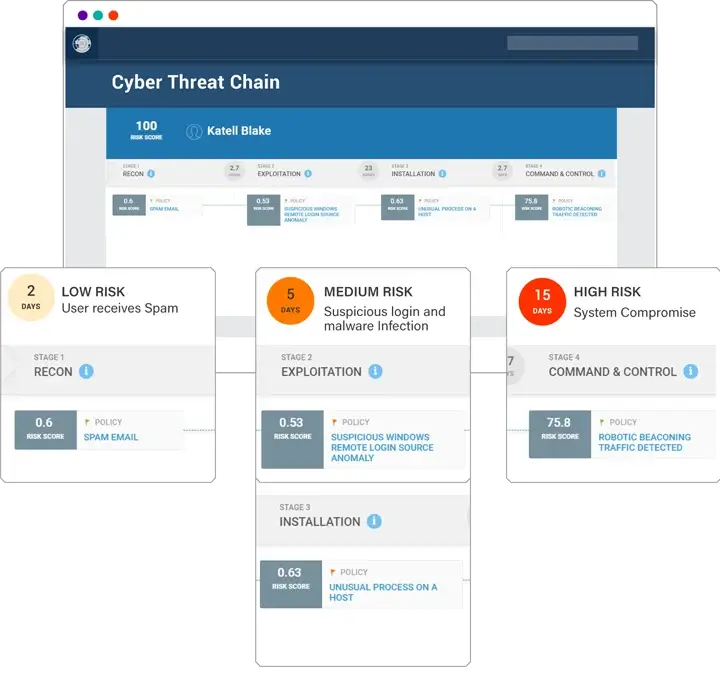
Proofpoint Insider Threat Management focuses on capturing detailed endpoint activity and providing evidence-based insights into risky user behavior. The platform records actions such as file transfers, application usage, and web activity, allowing organizations to reconstruct incidents and determine whether sensitive data was mishandled.
This level of visibility is particularly valuable for investigations involving HR or legal teams because it provides verifiable evidence of user activity. The platform also supports policy-based detection and alerting to identify suspicious behavior patterns.
Key Features
- Endpoint activity monitoring and recording
- Policy-based detection of risky user behavior
- Evidence collection for investigations
- Incident review and reporting tools
10. DTEX Systems
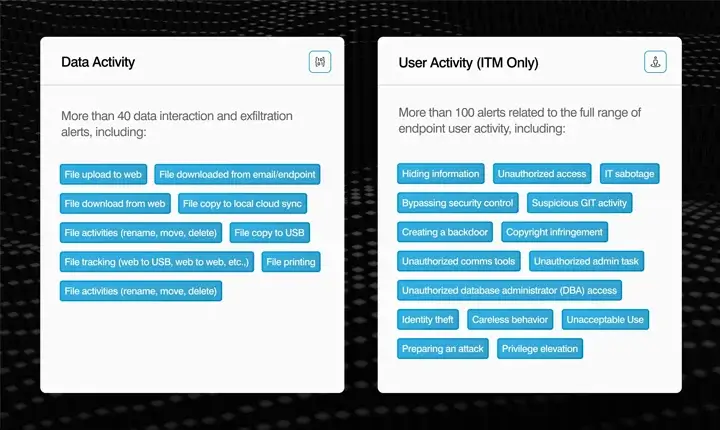
DTEX uses endpoint telemetry and user behaviour to assess risk through continuous monitoring of risk-based activity on all endpoints, which enables DTEX to alert on anomalous workflows prior to causing significant damage, but is also useful when tracking unexpected data flow across endpoints or sudden user changes in activity.
Key Features
- Continuous endpoint telemetry
- Behavior baselining and exfil detection
- Dashboards for rapid triage
11. Forcepoint Insider Threat
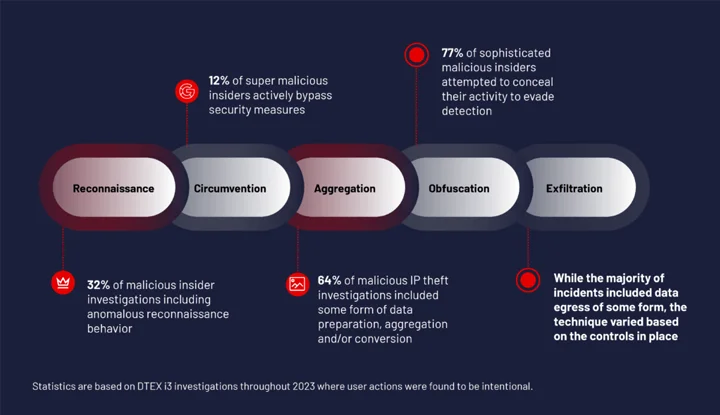
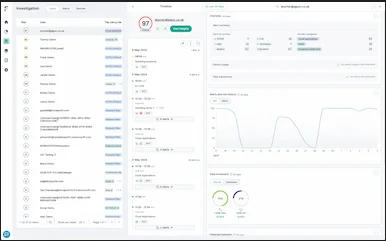
Forcepoint uses policies and user behaviour analysis to help organizations eliminate risky user behaviour through the blockage of data transfer when necessary; this process includes linking content policies with user signals so that they can be clearly enforced.
When combining policy and behaviour detection, Forcepoint is a preferred choice for organizations as it provides the business workflow to eliminate risks
Key Features
- DLP integration with behavior analytics
- Policy-triggered actions and blocking
- Incident review and reporting
12. Gurucul Insider Risk Management
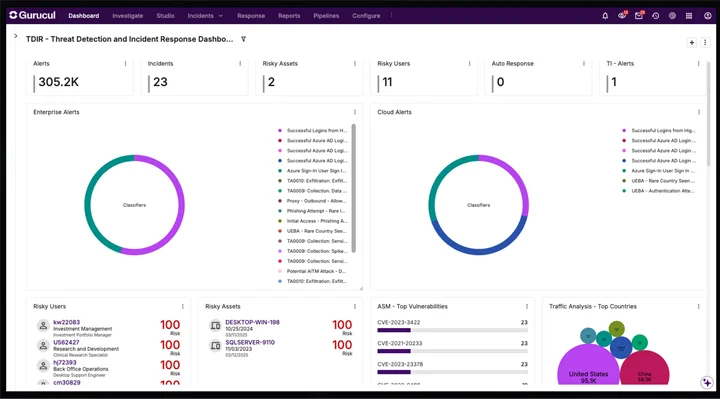
Gurucul uses machine learning to create risk scores from identity and behavior signals. It highlights high-risk users and supports investigations with flexible analytics.
This tool is suited for teams that want ML-based prioritization of insider risk and flexible deployment choices.
Key Features
- ML-driven risk scoring
- UEBA and identity analytics
- Case workflow support
13. Rapid7 InsightIDR
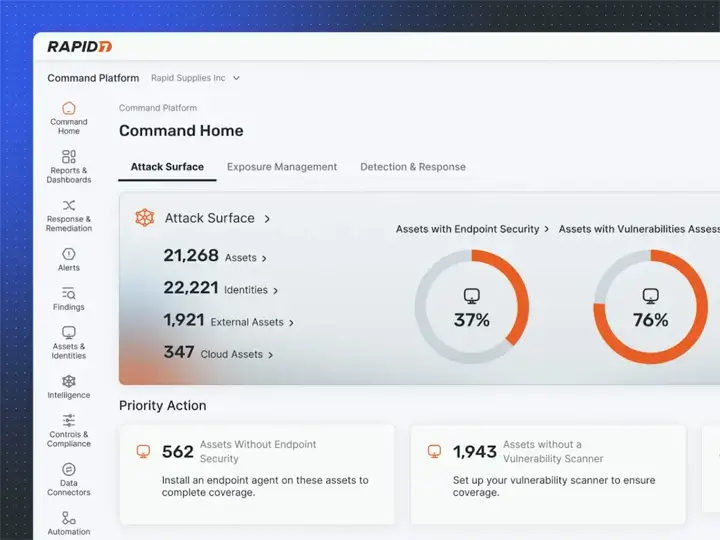
The InsightIDR solution gathers and analyzes user and entity behavior analytics (UEBA) from logs, endpoint telemetry, and security events for the detection of account compromise and risky behavior. InsightIDR allows you to quickly achieve value from your deployment, even with out-of-the-box detections.
In addition, InsightIDR was designed to be an integrated product with assistance for the investigation process through detection guidance and Active Directory logging support; therefore, it will make it easy to conduct an investigation efficiently.
Key Features
- Built-in AD detections and UEBA
- Endpoint telemetry and log collection
- Guided investigations and playbooks
14. Veriato Insider Risk Management
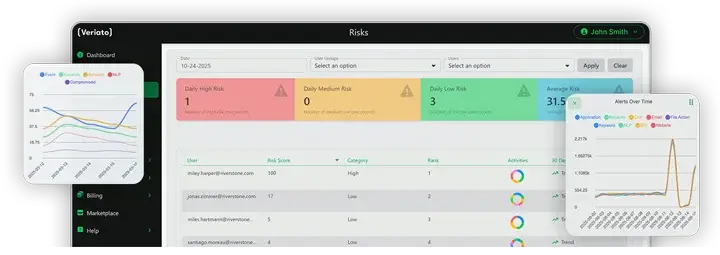
Veriato records the actions of users and utilizes behaviour analytics to detect potentially inappropriate or harmful behaviour and data exfiltration. Veriato produces granular timelines of user activity and will assist with investigations by providing detailed evidence and timelines of activity for each user.
Veriato is used when it is necessary for investigators to have evidence that is both easily reproduced/replayed and meaningful for HR and/or legal reviews.
Key Features
- User activity recording and playback
- Behavior scoring and alerts
- Timeline reports for investigations
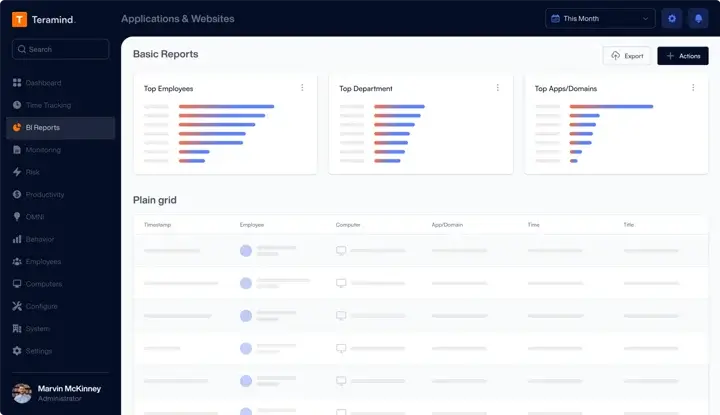
15. Teramind Insider Threat Detection
Teramind records the user’s screen, keyboard strokes and file activity, then analyses the records for use in identifying suspicious behaviour. It provides session playback and rule-based detection capabilities to allow for rapid evidence collection.
Due to its combination of high-quality session-level visibility with various forms of automation, many companies choose Teramind in order to be able to identify, prevent, and respond effectively to the potential for risky behaviour in real time.
Key Features
- Session recording and playback
- Rule-based and behavior detection
- Real-time blocking and alerts
16. Code42 Incydr (Mimecast)
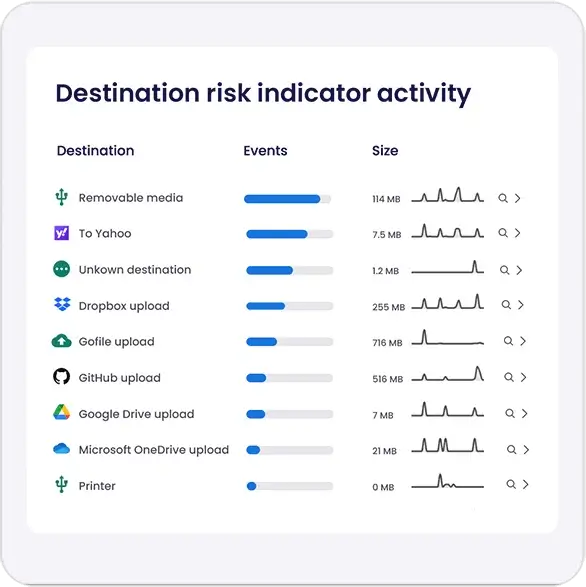
The Incydr product addresses data transfer and file-based risk. It allows users to monitor risky file activities across their endpoints and cloud-based files and ties those activities back to the end-user’s identity for investigation purposes.
If your company’s primary goal is to safeguard company-library files (i.e., IP) while being aware of how sensitive files are accessed/copied, select Incydr.
Key Features
- File activity monitoring and exfil detection
- User context and incident prioritization
- Cloud and endpoint coverage
17. Syteca (formerly Ekran System)
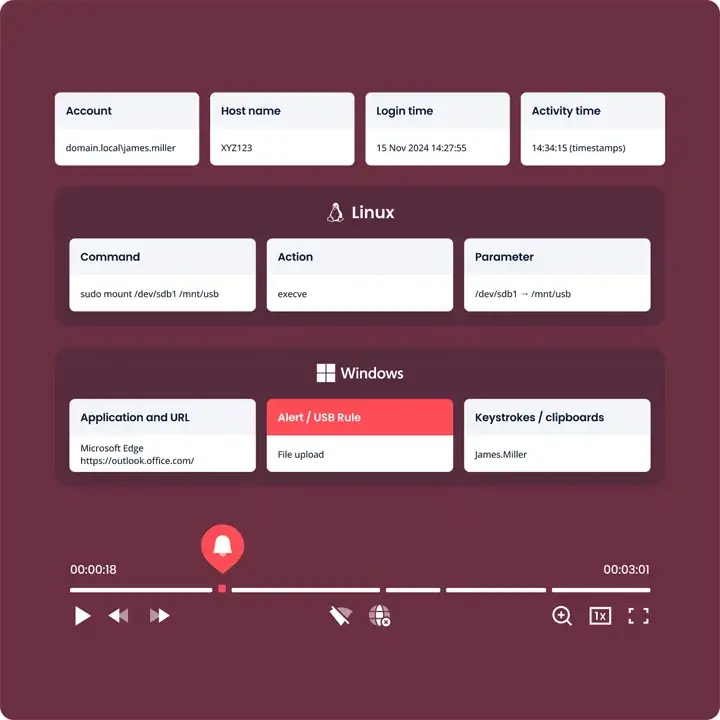
Syteca provides session recording and privileged user monitoring with on-prem or hybrid deployment. It captures exact user actions during privileged sessions for later review.
This is a solid option when regulated environments require local control and detailed privileged session evidence.
Key Features
- Privileged session recording
- Alerting on risky commands or actions
- Playback and audit export
18. Quest ITDR / Security Guardian
Quest’s ITDR offerings monitor identity signals and help trace identity attack chains in AD and hybrid estates. They focus on detecting identity misuse and guiding containment steps.
This fits AD-heavy environments where identity-focused detection and remediation guidance are needed.
Key Features
- Identity attack detection and playbooks
- AD posture checks and risk alerts
- Guidance for containment and remediation
19. Varonis Insider Risk Management
Varonis associates Active Directory permissions with user activity on both files and mailboxes and, through behaviour analysis, identifies risky actions being taken by users. With this, it allows you to see not only who has access (could access) sensitive data, but also who actually accessed it (did access).
If your insider risk programme uses mapping data exposure and/or investigating file system usage/behaviour analytics, then Varonis is a good product for your solution.
Key Features
- Data access analytics and exposure mapping
- Behavior-based alerts on risky file use
- Permission cleanup recommendations
20. Netwrix Insider Threat Detection
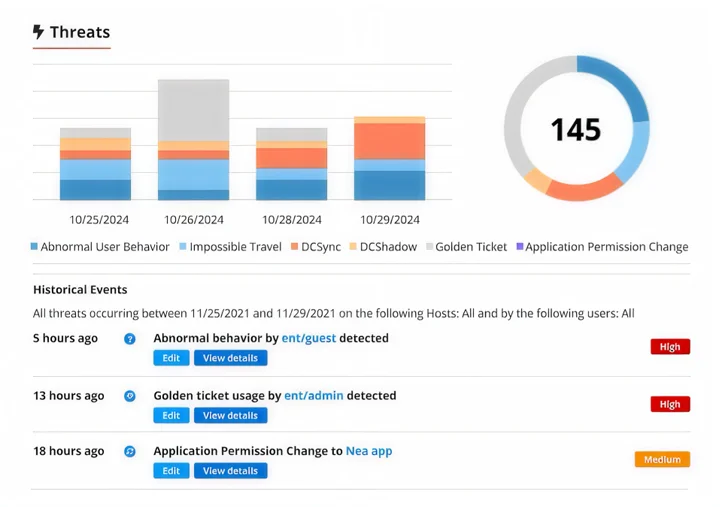
Netwrix Insider Threat Detection helps organizations identify malicious or negligent insider behavior by monitoring user activity across identity and data-centric systems.
Key Features
- User behavior monitoring: Detects abnormal access patterns and risky actions across Active Directory and file servers
- Change and access auditing: Tracks who accessed or modified sensitive data and system configurations
- Real-time alerts and reporting: Provides instant alerts and detailed reports to support quick investigation and compliance
Conclusion
Pick tools based on the signals you can collect and the proof you need. If your environment is AD-centric, prioritize products that ingest Windows security events and link them to user context. If data theft is your top concern, choose data-centric monitoring. If privileged misuse is the issue, look for session capture and privileged controls.
Frequently Asked Questions
Authentication and logon events are the most critical starting point. Beyond that, prioritize privileged group membership changes, file access on sensitive shares, and endpoint process and network connections. Add session recording for high-risk admins. If you collect those signals and link them to the same user identity, you get real, actionable context.
These tools ingest AD logs, Windows security events, authentication data, and sometimes endpoint activity. They build a baseline of normal user behavior and then flag deviations, such as off-hours access, sudden privilege escalation, or mass file activity. The goal is context, not just alerts.
UEBA tools focus on identifying anomalies by modeling normal behavior across users and systems. Insider threat tools go a step further by adding investigation workflows, evidence collection, policy enforcement, and sometimes session recording. Many modern platforms combine both approaches.
Endpoint monitoring is not always required but adds strong context for high-risk users. AD logs show what permissions exist and when access happens. Endpoint telemetry shows what the user actually did. For high-risk users or sensitive data, combining both gives much stronger evidence.