


Last Updated on May 27, 2026 by Ashok Kumar
Organizations are generating, capturing, and storing huge volumes of data, both structured and unstructured, at cloud SaaS endpoints and within an enterprise’s premises. Without categorization, this data landscape is vulnerable to excessive exposure, inappropriate use, or leakage.
Sensitive data (including PII data, financial data, Intellectual property data, and regulated data) is at risk. Now, through today’s data discovery and classification tools, we can help companies discover, classify, label, and protect their sensitive data, while guiding compliance to GDPR, HIPAA, PCI DSS, SOX, and NIS2.
In 2026, the focus is on AI-ready security with AI-ready features, real-time risk context, auto-remediation and hybrid cloud scope.
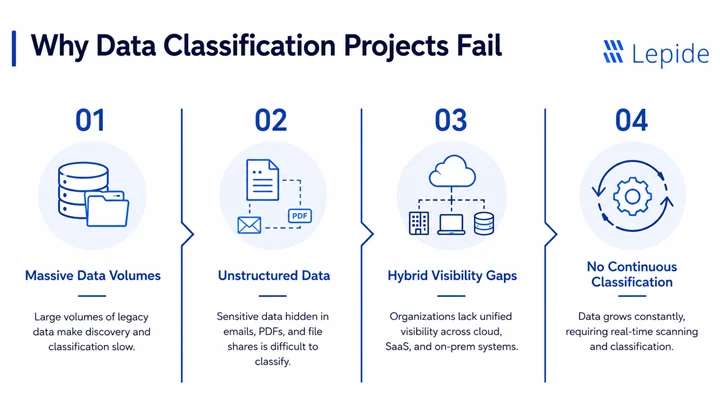
Lepide’s Perspective: Why Data Classification Projects Fail
Here are some of the most common reasons why data classification projects fail:
- Massive Volumes of Existing Data: When searching for large quantities of existing data spread throughout file servers, SaaS applications, and cloud storage systems it can take significant amounts of time and resources to identify and classify the initial data set. This often surprises many organizations.
- Unstructured Data Complexity: Sensitive/protected or personally identifiable data is often stored in unstructured ways like bulk shares and e-mail PDF captures, and there is significant challenge in accurately classifying data.
- Visibility Gaps Across Hybrid Environments: Today, companies are storing data in clouds, 365 SaaS applications, on-premises environments, etc. Some solutions may not have the capability to deliver unified visibility across all these repositories.
- Lack of Continuous Classification: Because of the sheer time it takes to fully scan and classify sensitive data across the average organization, continuous scanning at the point of creation is a necessity. Classification must keep pace with the growth of the number of files users, cloud services, and AI techniques.
How to Choose the Best Data Classification Tool for Your Business
To select a data classification tool that fits your security and commercial objectives, you will need to assess features, scalability, compliance support, and practical use.
1. Identify your Data Environment
Few companies have simple environments; in many cases, companies run a hybrid environment that includes file servers, SaaS applications, cloud storage, and databases. An adequate classification platform would manage:
- Structured and unstructured data
- Cloud and on-premises repositories
- SaaS applications
- Endpoint visibility
- Multi-cloud environments
Organizations with hybrid environments should look for a portal that will provide one centralized location where all the data sources can be overseen.
2. Prioritize Real-Time Risk Detection
Today’s threats change quickly; because of this, access and insider threats unmask data by AI. There are several mechanisms that integrate classification with DSPM and DLP. Choose the tools that provide:
- Real-time monitoring
- Excessive permission detection
- User behaviour analytics
- Automated remediation
- Abnormal access alerts
3. Check for Automated Classification
Manual classification is slow, inconsistent, and difficult to scale. Automated classification significantly reduces administrative overhead by improving classification accuracy. Modern solutions use:
- AI-powered discover
- Pattern matching
- Behavioural Analytics
- Labeling with context awareness
4. Evaluate Compliance Support
The ideal solution should make compliance activities easier by assisting with:
- Recognizing Regulated Information
- Create Reports for Audits
- Monitor Permissions for Access
- Identify Policy Violations
- Implement policies for protection and retention.
GDPR, HIPAA, PCI DSS, SOX, NIS 2, and CCPA should be looked up in the pre-built compliance templates.
5. Examine Ease of Deployment
Some corporate platforms can be operational in a few days, but others require a dedicated team and several months of implementation. Mid-sized businesses tend to choose solutions that are easy to manage and can be deployed more rapidly.
- Complexity of Deployment
- Curve of Learning
- Scalability
- Overhead in Administration
6. Assess AI and Gen AI Security Capabilities
Data classification is now a fundamental component of AI governance as companies use Copilot, ChatGPT, and generative AI. At the moment, the top tools offer:
- Monitoring AI SaaS usage in real time
- AI-sensitive data security based on browsers
- Labeling and Examining AI remarks
What Most Buyers Get Wrong
Most organisations approach data security from the data outward. They focus on discovering sensitive files, classifying information, and monitoring where data lives. While important, this data-centric approach often ignores where most real-world threats actually begin: identities and permissions.
Users, groups, service accounts, inherited permissions, and misconfigured access are what ultimately determine who can access sensitive information and what they can do with it. This creates what Lepide describes as the “Identity Data Disconnect” – a gap between understanding where sensitive data exists and understanding which identities can actually access it. Without connecting these two worlds together, organisations struggle to prioritise risk effectively or reduce exposure at scale.
To close this gap, organisations need to start with identities first. That means understanding who their users are, how permissions are assigned, where privilege has accumulated over time, and how access is changing across the environment. Once this visibility exists, it can then be linked directly to sensitive data to provide meaningful risk context. Instead of simply knowing that sensitive data exists somewhere in the environment, security teams can identify which users have unnecessary access, where permissions sprawl exists, and which exposures present the greatest risk to the organisation. This identity-first approach provides a far more operational and actionable foundation for modern data security.
Quick Comparison of the Best Data Classification Tools
Lepide’s Evaluation Perspective
Organizations are interested in moving from standalone discovery tools to integrated platforms with data classification combined with access governance, behavioral monitoring, and AI-enabled security controls due to the growing shifts in data security needs and expectations. The extended evaluation criteria included hybrid visibility across on-premises and cloud, audit and risk detection in real-time, scalability for enterprise scale, permission analysis and access governance, and compliance reporting.
In evaluating the best classification tools for 2026, Lepide focused not only on discovery accuracy but also on truly understanding the Identity-Data Disconnect, gradually incorporating data security into a unified platform.
| Tool | Best For | Deployment | Core Strength | Limitation |
|---|---|---|---|---|
| Lepide Identify |
Companies looking for data classification and identity visibility | On-Prem, Cloud, Hybrid | Automated sensitive data classification combined with risk-based insight, permission analysis, and compliance-driven reporting | Less extensive global presence than some of the larger enterprise vendors |
| Varonis | Organizations with large number of unstructured data | Hybrid | Granular classification of sensitive files coupled with behavioral analysis and access insight | Difficult to deploy and has a steep learning curve |
| Netwrix | Enterprises that value audits and compliance | Hybrid | Sound data classification for audit, regulatory reports, and access control | Limited remediation automation capabilities |
| Forcepoint | Designed for businesses that want integrated DLP and classification | Cloud/Hybrid | AI-powered data classification and policy-based protection across endpoints and cloud apps. | Difficulty in configuring and turning on complex policies. |
| BigID | Data discovery and classification for structured and unstructured sensitive data | Cloud/On-Prem | Powerful data discovery and compliance | Complex implementation |
| Spirion | Organizations focusing on locating PII | Cloud/Hybrid | Precise categorization of PII, PHI, and other compliance information throughout the system, environment, and network | Complex initial configuration and oversight |
| Securiti | Multi-cloud organizations implementing DSPM | Cloud | AI-powered automation and intelligent access | For outdated systems, less developed |
The Best Data Classification Tools for 2026
1. Lepide Identify
Lepide Identify (Part of Lepide Data Security Platform) is a complete identity security and data classification solution that enables organizations to discover, classify, audit, and secure sensitive data across hybrid environments. It integrates auto data classification, permission analysis, identify threat visibility and compliance reporting in a single interface. The persistent data classification at the point of creation helps to build a picture of sensitive data and satisfy compliance requirements.
Key Features
- Real-time data detection
- Permission Analysis and least Privilege enforcement
- Insider threat detection
- Automated sensitive data discovery
- Compliance reporting for GDPR, PCI DSS, HIPAA, and more
- Ransomware detection and response
Best For: Organizations that are fit for mid-sized organizations are looking for a balance of data classification, auditing, compliance, and access governance in a hybrid environment.
2. Varonis
Varonis is one of the recognized names in data discovery and classification that creates a comprehensive record of sensitive data, analyzing permissions, and monitoring abnormal user behaviour across file servers, SharePoint, and cloud storage. It specializes in permission visibility and risk analysis in complex enterprise environments. Organizations with large file systems and compliance-heavy workloads rely on its advanced analytics capabilities.
Key Features
- Unstructured data classification
- Compliance dashboards
- File Activity monitoring
- Automated labeling
- Insider threat detection
- Behavioural analytics
Best For: Large Organizations that need to protect highly sensitive unstructured data that requires automated threat detection and compliance tracking.
3. Netwrix
Netwrix offers data classification and data security capabilities designed to help organizations identify sensitive information, reduce data exposure risks, and strengthen compliance initiatives. The platform focuses on discovering regulated and business-critical data across file servers, cloud platforms, SaaS, and AI-connected platforms, expanding the attack surface faster while providing detailed auditing and access intelligence.
Key Features
- Sensitive data discovery and classification
- Remediate data exposure
- Monitor activity and detect threats
- Monitor activity and detect threats
- Hybrid environment visibility
Best For: Mid-sized organizations that operate under strict regulatory compliance are looking to unify identity, privilege, and data security.
4. Forcepoint
Forcepoint gives consolidated data classification, DLP, and DSPM for access governance in its Data Security cloud platform. With cloud, on-premises, and hybrid clouds possible, this system allows the control of policies while keeping a track of high-risk user behavior.
Key Features
- Cloud and endpoint protection
- Real-time risk monitoring
- AI-powered classification with large language model accuracy
- Flexible deployment
- Unified DLP and DSPM
- Cross-environment policy enforcement
Best For: Reporting day- to-day operations for sophisticated large- sized enterprises.
5. BigID
BigID puts a strong emphasis on privacy-led data discovery and classification of all data types: structured, semi-structured, and unstructured data. BigID classifies sensitive personal, regulated, and toxic combinations of data better than other solutions. Its machine learning capabilities assist organizations in locating sensitive data and aid compliance and governance activities.
Key Features
- AI-powered discovery
- Cloud and SaaS Integrations
- Structured and Unstructured data visibility
- Data inventory management
- Policy-driven discovery
Best For: Large, heavily regulated Enterprise with data discovery, strict privacy compliance, and AI-governance.
6. Spirion
Spirion offers discovery and classification of sensitive data with excellent tools for PII discovery and risk reduction. Spirion is used by organizations to find sensitive data across endpoints, cloud repositories, email, and file systems.
Key Features
- Reduce risk exposure
- Classification policies
- Compliance reporting
- Automated reporting
- Endpoint scanning
- Data risk remediation
Best For: Organizations seeking to automate the classification of data and enable the smooth invocation of data-centric encryption.
7. Securiti
Securiti offers AI-based data governance and DSPM support for cloud- native environments. The software automates data mapping, analyzes data entitlement and access governance throughout SaaS and cloud repositories.
Key Features
- AI-driven classification
- Multi-cloud visibility
- Data access intelligence
- SaaS governance
- DSPM capabilities
- Automated least privilege enforcement
Best For: An industry with lots of regulations, and a large organization that is deploying generative AI at scale in a security-conscious way.
How AI and Copilot Are Changing Data Classification
The concept of data classification is evolving in the current security model as the AI platform economy develops (see Microsoft Copilot, ChatGPT, etc.).
With this new mindset, businesses can no longer approach data classification as only a compliance-related activity, in which the organization just locates all the sensitive files.
AI does not introduce novel permission vulnerabilities; it rather enhances the already existing difficulties of permission elevation and oversharing at a new speed. Doing so has technically led organizations to expand the scope of their definition of what perfect data classification includes.
It’s not just about revealing sensitive content, but security needs to know who will be viewing this material, to identify where the permission begins to occur, and how AI systems may use the identified data in a hybrid context.
Yet, as AI is deployed in the day-to-day, classification should become a core part of AI governance, insider threat prevention, and other broader information security strategies.
Conclusion
Classifying data has long moved beyond assigning labels; it looks like this year, companies will rely more on platforms that provide discovery governance compliance, access intelligence, DLP & AI security features as a single integrated solution.
Organizations with over-complex file systems have historically purchased Varonis, while privacy-conscious organizations lean toward BigID.
Yet, other companies coming after the fast deployments, hybrid visibility, simplified compliance reporting, and permission analysis might be under the comfort of Lepide.
Finally, the best classification tool will always depend on your infrastructure, compliance requirements, security maturity level, and long-term governance strategy.
Frequently Asked Questions
Yes, today there are a lot of common platforms for the governance of an AI, prompt monitoring, sensitive data labelling, and even AI-related DLP controls.
Cloud native tools can be deployed in days. Enterprise platforms may take weeks/months, given the complexity/integrations.
For the hybrid environments, tools like BigID, Microsoft, and Netwrix are the best as they can discover sensitive information both on-premises and on cloud platforms from one user interface.
Data classification allows organizations to secure sensitive information, minimize the risk of breaches, implement access restrictions, and ensure compliance.