Last Updated on June 12, 2026 by Satyendra
The rapid adoption of AI is outpacing many organizations’ ability to regulate it properly. Businesses are pouring money into AI-based solutions across all areas, including copilot automation, generative AI, and shadow AI.
A major source of enterprise AI risk comes from how AI systems interact with existing identity, access, and data governance controls, which can amplify underlying permission weaknesses. Beyond AI itself, there are still security vulnerabilities in Active Directory, SharePoint, Microsoft Teams, file shares, and hybrid collaboration environments that AI often worsens.
This article discusses the main AI risks that organizations are exposed to, the role of AI in enterprise data security, and effective ways to reduce security and governance risks.
What is AI Risk in the Enterprise Context?
Organizations that use or deploy AI are exposed to multiple risk categories, including operational, security, privacy, regulatory, reputational, and model-related risks. However, these risks, as well as related controls such as data governance, access controls, regulatory compliance, employee behavior changes, and supply chain disruptions, do not necessarily operate in isolation.
An important security risk of AI is the tendency to build artificial intelligence on top of a loose identity and permission management system. Most organizations creating an AI governance policy tend to ignore the existing identity exposure problem.
For CISOs, AI can be a source of new threats and the possibility of data exposure; for GRC managers, it is a liability for compliance and regulations; and for IT directors, it means even more ungoverned integrations, shadow AI usage, and access drift that can cause sleepless nights. Each risk has its own unique characteristics and requires a different kind of response from the relevant oversight function.
Top AI Risks Facing Enterprises in 2026
The risks below highlight where incidents are most likely to originate and what security, governance, and IT leaders can do before they occur.
1. Shadow AI and Ungoverned Employee Usage
Shadow AI is the use of AI applications by employees without proper authorization, security reviews, or management oversight, essentially the AI-era equivalent of shadow IT.
Although it is usually harder to see the data exposure, the risks are still very high.
According to industry surveys, a large proportion of AI use in companies occurs through third-party, non-sanctioned tools, meaning many organizations are exposed to shadow AI without even realizing it.
Organizations sometimes find it difficult to differentiate between the use of AI for legitimate work purposes and reckless activities involving sensitive data. Employees might think that AI prompts are confidential, whereas security teams often have no visibility into what information is being processed, summarized, or exposed.
Mitigation
- Keep track of web proxies and endpoints to identify the use of AI tools even before implementing policies.
- Make shadow AI a focus of your communication policy and train employees on data security.
- Maintain an up-to-date list of approved AI tools and provide a simple, regulated method for gaining access rather than encouraging employees to bypass the system.
2. AI-Driven Insider Threats
AI tools can significantly increase the speed at which insiders analyze and retrieve data they already have access to, potentially amplifying insider risk.
Microsoft Copilot inherits Microsoft 365 permissions and can surface information that users already have access to, especially when existing permissions are overly broad or poorly governed. In the absence of effective least-privilege controls, AI can reveal far more information than intended.
Organizations pay a great deal of attention to prompt oversight and AI-related policies. However, the primary problem usually lies with unmanaged identities and excessive privileges that existed long before the arrival of AI.
Organizations that want to understand and monitor insider risks in all their forms, whether AI-assisted or not, should consider insider threat detection an essential capability rather than merely a reactive measure. The combination of behavioral baselines, access visibility, and real-time alerting enables organizations to detect AI-enhanced insider activity before it spirals out of control.
Mitigation
Configure access controls to ensure behavioral analytics can detect unusual data access patterns, such as excessive querying or downloading through AI tools. Update insider threat procedures and incident response playbooks to address AI-assisted data access incidents. Before deploying AI assistants, review permissions to ensure all accounts accessing sensitive data follow least-privilege principles.
3. Data Poisoning and Model Integrity Risk
Data poisoning occurs when an individual deliberately introduces or modifies corrupted data within AI training datasets, resulting in incorrect outputs, biased decisions, and diminished model reliability.
As AI adoption expands across departments and platforms, organizations often struggle to maintain visibility into which datasets are used, who can modify them, and whether governance controls are consistently enforced.
If machine learning models or AI-driven detection systems are poisoned, real warnings may not be raised, threats may be incorrectly identified, and false positives may increase significantly, creating major challenges for security operations. In areas such as hiring and lending decisions, poisoned data can introduce unfair bias, leading not only to poor decisions but also to increased reputational, legal, and financial risk.
Mitigation
- Apply role-based access control (RBAC), dataset integrity monitoring, and dataset versioning through controlled and auditable training data pipelines.
- Require AI vendors to provide data provenance, training governance, and integrity validation, and monitor datasets for unauthorized changes whenever possible.
4. Model Access Governance and Permission Overreach
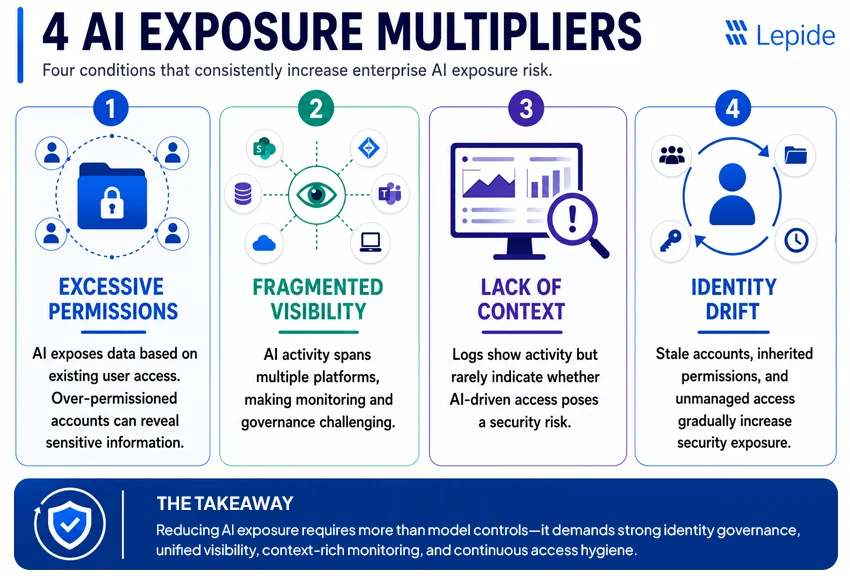
Among corporate AI risks, one that is often overlooked is permission-based data exposure. AI assistants typically inherit user access rights, which can result in them revealing far more data than users would normally encounter.
This exposure develops gradually through inherited permissions, nested groups, rushed onboarding, temporary access, abandoned projects, and stale administrative relationships.
As a result, AI exposure is primarily a visibility problem before it becomes a compliance or governance issue. Organizations cannot effectively classify, monitor, or govern data that is invisible to them, particularly in hybrid environments.
Mitigation
- Conduct a thorough access audit before deploying an enterprise AI assistant to uncover unnecessary privileges, outdated permissions, and sensitive data that has not yet been classified.
- Establish a mandatory access governance checklist and use data discovery and classification tools to locate sensitive files.
- After deployment, apply classification labels, restrict access to sensitive data, and regularly monitor file usage.
5. Bias in AI Systems and Automated Decision-Making
AI systems trained on historical data may inherit and amplify existing biases, depending on data quality, feature selection, and model design. This can affect areas such as hiring, credit approvals, security alerts, and customer profiling.
These issues create legal, reputational, and operational risks, exposing organizations to discrimination claims, regulatory scrutiny, and inaccurate outcomes that users may trust simply because they are generated by AI.
In cybersecurity, biased AI systems may alter risk scores, lowering them for certain user groups or suppressing alerts that would normally be triggered. In the worst-case scenario, legitimate activity may be incorrectly classified as fraudulent due to underlying bias within the model.
Mitigation
- Require AI vendors to provide bias evaluation reports as part of the procurement process and consider independent bias assessments.
- Align AI-driven decisions with existing anti-discrimination laws and maintain human oversight for significant outcomes.
- Preserve version histories of training datasets to support investigations into complaints and identify demographic proxies present in historical data.
6. AI-Specific Cybersecurity Threats: Prompt Injection and Adversarial Attacks
Prompt injection attacks occur when malicious instructions are embedded within user inputs or external data sources, such as documents or web content, causing a model to override intended instructions or expose unintended data.
Similarly, adversarial attacks manipulate input data to generate incorrect or deceptive AI outputs.
As organizations increasingly connect AI tools to internal systems, APIs, and data repositories, attackers may exploit untrusted sources such as emails or web pages to launch prompt injection attacks. Studies have shown that enterprise AI assistants can be manipulated in test environments, and the risk continues to grow as these systems become more autonomous.
Mitigation
- Implement security controls at AI integration points, including input validation, output monitoring, and anomaly detection, to identify potential threats throughout AI workflows.
- Include prompt injection and adversarial attack scenarios in AI risk assessments and ensure vendors address these risks within their security disclosures.
- Restrict AI operations that can execute without human oversight, as human validation of critical actions significantly reduces the impact of a successful prompt injection attack.
7. Regulatory Exposure and AI Compliance Obligations
As AI regulations continue to evolve, organizations that deploy AI without a formal compliance program may face legal risks, enforcement actions, and reputational damage.
With the enforcement of the EU AI Act and other AI-specific regulations, organizations must ensure compliance with both existing data protection laws, such as GDPR and CCPA, and emerging AI-specific regulatory requirements.
The challenge is further complicated by the fact that many organizations lack visibility into where AI systems are operating, despite this being a key requirement for compliance with most new AI regulations.
Mitigation
Catalog AI solutions according to the risk levels defined by the EU AI Act and ensure high-risk deployments are supported by appropriate documentation, testing, monitoring, and oversight measures.
Integrate AI compliance into existing governance programs.
Conduct quarterly reviews of AI applications against newly introduced regulations while maintaining a repository of audit-ready evidence, as regulators increasingly require proof of ongoing oversight rather than simply documented policies.
AI Risk Management Framework Essentials
An effective AI risk management framework is not a single policy. It is an operational capability that must run continuously alongside AI adoption.
The essentials of a working AI risk management framework:
- Govern: Establish ownership. Define who is responsible for AI risk across security, compliance, IT, and business functions. Without clear ownership, governance defaults to nobody.
- Map: Build and maintain your AI inventory. You cannot govern AI that you do not know exists. This includes approved deployments, embedded AI within SaaS platforms, and shadow AI usage.
- Measure: Conduct structured AI risk assessments before deployment and on a recurring basis. Use consistent criteria, including data sensitivity, decision impact, regulatory exposure, access scope, and bias risk.
- Manage: Enforce access controls, deploy monitoring, establish incident response procedures for AI-related events, and maintain audit documentation that can withstand regulatory scrutiny.
Role-Based Mitigation Strategies for CISOs, GRC Managers, and IT Leaders
With AI introducing a broad range of risks, it is unrealistic to expect a single department to be solely responsible for AI risk mitigation. Effective AI governance requires coordinated action across security, governance, and technology leadership.
- For CISOs: Visibility and detection should be the top priorities. CISOs need to understand where AI is being used, what it can access, and how to monitor it through SIEM platforms, anomaly detection systems, and security reviews of AI integration points.
- For GRC Managers: GRC managers typically focus on AI governance and compliance, including maintaining AI inventories, conducting risk assessments, performing vendor due diligence, and integrating AI oversight into audit, policy, and regulatory processes.
- For IT Directors: IT directors are primarily concerned with access governance and monitoring. They need to review permissions, enforce least-privilege principles, classify sensitive data, and log AI-related activities.
Regardless of role, a successful AI governance program requires visibility into data exposure, permissions, identity relationships, and abnormal access patterns.
How Lepide Helps Organizations Reduce AI-Related Security and Data Risks
AI tools such as Microsoft Copilot operate within existing Microsoft 365 identity and access permissions and can only surface data that users are already authorized to access. As a result, many organizations discover that long-standing permission issues, excessive access rights, and sensitive data exposure become significantly more visible after AI implementation.
With Lepide, organizations can mitigate AI-related data risks by identifying sensitive data, determining who has access to it, and highlighting excessive permission levels that may lead to the exposure of confidential information through AI-driven searches and responses. Through a combination of identity visibility, permissions analysis, and data discovery, Lepide enables security teams to identify and remediate risky access before it develops into an AI-related security incident.
Lepide also provides audit trails and user behavior monitoring to help organizations understand how sensitive data is accessed, shared, and used throughout their environment. Security teams can leverage this information to investigate suspicious activity, demonstrate compliance, and confidently adopt AI technologies while maintaining control over their most valuable information assets.
Related Article:
Frequently Asked Questions
The top AI risks facing enterprises in 2026 include shadow AI, employees using AI without governance, AI-driven insider threats, data poisoning, access governance failures, biased automated decision-making, prompt injection attacks, and rapidly evolving AI regulations.
Most of these risks are closely tied to data governance. This means that strong visibility and effective access controls are essential for successful risk mitigation.
An enterprise AI risk management framework is a structured approach for identifying, assessing, and managing AI-related risks across the organization.
The widely adopted NIST AI RMF is built around four core functions: Govern, Map, Measure, and Manage. As a governance framework, it should be operationalized through supporting technologies, clearly defined ownership, and continuous review processes rather than being treated as a simple compliance checklist.
AI risk assessments should evaluate data classification, access scope, potential business impact, vendor-related risks, and regulatory compliance requirements.
Organizations handling sensitive data, operating in regulated industries, or using AI to support critical decision-making should treat these areas as high-risk and implement stronger controls together with increased human oversight.
The EU AI Act establishes a framework that categorizes AI systems into Unacceptable Risk, High Risk, Limited Risk, and Minimal Risk classifications.
High-risk AI systems used in areas such as recruitment, credit scoring, law enforcement, healthcare, and critical infrastructure must comply with requirements related to conformity assessments, technical documentation, human oversight, transparency, and ongoing monitoring.