


Last Updated on June 8, 2026 by Ashok Kumar
Ransomware has evolved far beyond the smash-and-grab attacks that once relied on a single malicious executable. Today’s ransomware operators behave more like advanced persistent threat groups. Before encrypting a single file, they often spend days or even weeks harvesting credentials, escalating privileges, identifying sensitive data, disabling security controls, and moving laterally across the environment.
This shift has fundamentally changed what organizations should expect from ransomware protection tools. Detecting malicious code is still important, but it is no longer enough. Security teams need visibility into user behavior, permissions, sensitive data access, privileged accounts, and suspicious activity patterns that indicate an attack is unfolding long before encryption begins.
Many organizations already have endpoint protection, backup solutions, SIEM platforms, and MFA in place. Yet ransomware incidents continue to occur as attackers increasingly exploit operational blind spots, including excessive permissions, dormant accounts, unmanaged service accounts, and fragmented visibility across hybrid environments.
This article analyzes 10 leading ransomware detection and protection tools for 2026 and explores how organizations can select the right solution based on their security requirements, infrastructure, and risk profile.
How to Choose the Right Ransomware Detection and Protection Tool
The market for ransomware tools is loud and crowded. Vendors lead with threat intelligence, AI-powered detection, and rollback features, all of which matter, but they rarely talk about the operational realities that determine whether a tool actually reduces your risk or just produces faster incident reports. Here is what to evaluate.
- Best for Organizations That Want to Detect Ransomware Before Encryption Begins: Organizations still assume ransomware detection starts when files are encrypted. However, in reality, attackers often spend days escalating privileges, mapping sensitive data, and moving laterally before launching encryption. The right tool should detect early warning signs such as unusual logins, permission changes, abnormal data access, and suspicious account behavior before damage occurs.
- Best for Teams That Need Investigation Context, Not Just Alerts: Alerts alone rarely tell the full story. Security teams need context to understand who was involved, what data was affected, and how far an attacker moved. Look for solutions that enrich alerts with user identities, timelines, impacted systems, and correlated events to accelerate investigation and containment.
- Best for Organizations with Hybrid and Unstructured Data Environments: Many ransomware attacks ultimately target file servers, network shares, SharePoint, and other unstructured data repositories. If your environment includes hybrid infrastructure, ensure the platform provides strong visibility across these systems rather than focusing solely on endpoints or cloud workloads.
- Best for Security Teams That Need Automated Response, Not Just Detection: Detecting ransomware is only half the battle. Every minute matters once an attack begins. Solutions that can automatically isolate endpoints, disable compromised accounts, block malicious activity, and initiate response workflows can significantly reduce the impact of an incident.
- Best for Businesses That Require Immutable, Tamper-Resistant Recovery: Backups remain one of the most important safeguards against ransomware, but they are often targeted by attackers as well. Prioritize solutions that support immutable, air-gapped, or isolated recovery options to ensure critical data remains recoverable even if privileged accounts are compromised.
- Best for Compliance-Driven Organizations That Need Audit Evidence Alongside Protection: For regulated organizations, responding to a ransomware attack often involves audits, investigations, and reporting requirements. Choose a platform that maintains detailed, tamper-evident audit trails so security teams can quickly demonstrate what happened, who was affected, and how the incident was addressed.
Quick Comparison of the Top Ransomware Detection and Protection Tools
Before we get into the rankings, here is the blunt version. Some tools are better for identity-linked detection. Some are better for SaaS recovery. Some are better for endpoint response. Some are really backup companies with a security costume on. Lepide’s own list for this topic spans that range, from data security platforms to endpoint- and backup-centric tools.
| Tool | Best For | Deployment | Core Strength | Limitation |
|---|---|---|---|---|
| Lepide Data Security Platform | Organizations needing identity-aware ransomware detection across hybrid environments | On-premises, cloud, hybrid | Correlates file activity with AD users, permissions, and sensitive data for faster investigation and response | Strongest value comes when organizations want deep identity and data visibility, not purely endpoint-only protection |
| SpinOne RDR | Google Workspace and Microsoft 365 ransomware recovery | SaaS | Detects SaaS-based ransomware activity and enables rapid recovery using immutable backups | Limited focus outside SaaS ecosystems |
| Druva Data Resiliency Cloud | Cloud-first organizations prioritizing resilience and recovery | SaaS / cloud-native | Strong cloud-native backup, anomaly detection, and disaster recovery capabilities | Less focused on deep on-prem identity and permissions visibility |
| CrowdStrike Falcon | Enterprises wanting advanced endpoint-led ransomware defense | Cloud-delivered | Powerful behavioral analytics, threat hunting, and rollback capabilities | Can become expensive and operationally heavy at scale |
| Microsoft Defender for Endpoint | Microsoft-centric enterprises | Cloud and hybrid | Deep integration with Microsoft security ecosystem and automated response workflows | Best experience depends heavily on broader Microsoft stack adoption |
| Varonis | Data-centric security and insider threat visibility | Hybrid | Strong visibility into sensitive data access, permissions, and abnormal behavior | Deployment and tuning can require significant operational effort |
| SentinelOne Singularity | Organizations wanting an autonomous endpoint response | Cloud | AI-driven autonomous detection, remediation, and rollback | Endpoint-focused visibility may leave identity and data-context gaps |
| Acronis Cyber Protect | Businesses wanting combined backup and ransomware protection | Cloud, hybrid, on-premises | Unified backup, recovery, and malware protection platform | Security analytics depth is not as extensive as dedicated threat platforms |
| Rubrik Security Cloud | Enterprises focused on cyber resilience and immutable recovery | Hybrid and multi-cloud | Excellent immutable backup and rapid recovery capabilities | Primarily recovery-centric rather than identity-centric detection |
| Bitdefender GravityZone | Mid-sized organizations needing scalable endpoint protection | Cloud and on-premises | Strong endpoint detection and prevention with centralized management | Primarily focused on endpoint protection rather than data-centric visibility. |
Top 10 Ransomware Detection and Protection Tools
1. Lepide Data Security Platform
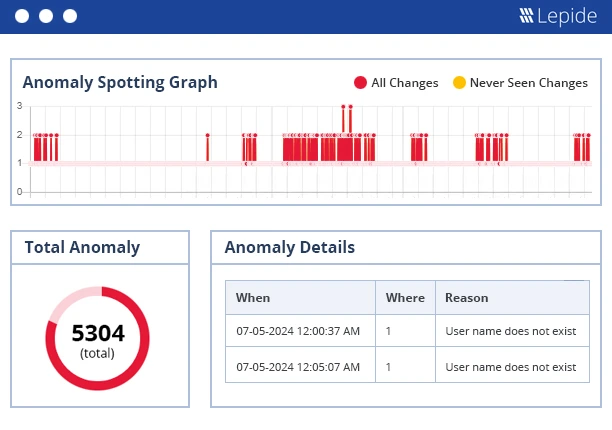
Lepide Data Security Platform focuses on detecting and investigating ransomware indicators by monitoring changes across Active Directory, Microsoft 365, file servers, and unstructured data environments. Unlike traditional endpoint security platforms that primarily focus on malware execution, Lepide emphasizes visibility into permissions, user activity, sensitive data access, and behavioral anomalies that frequently appear before ransomware deployment.
The platform provides auditing, threat detection, permissions analysis, sensitive data discovery, access governance, and User and Entity Behavior Analytics (UEBA). This allows organizations to identify unusual activity patterns that may indicate credential compromise, insider threats, privilege misuse, or ransomware reconnaissance activity.
One challenge many organizations underestimate is how much ransomware risk originates from visibility gaps rather than malware itself. Attackers frequently exploit excessive permissions, dormant accounts, inherited access, and poorly understood data exposure long before encryption occurs.
Security teams discover during investigations that years of nested Active Directory groups, permission sprawl, and forgotten service accounts have created attack paths nobody fully understands anymore.
If a compromised account suddenly accesses thousands of sensitive files, modifies permissions, and interacts with repositories it has never previously touched, those activities may indicate ransomware reconnaissance activity before encryption occurs.
Key Features
- Behavioral anomaly detection on file and identity activity (mass changes, deletions, renames, unusual access patterns)
- Active Directory change auditing with identity and permissions context
- Permissions risk identification and excessive access flagging
- User-to-data activity correlation for fast investigation and blast-radius scoping
- Automated alerts and response workflows for real-time incident containment
- SIEM integration for teams with existing security operations pipelines
- Continuous entitlement monitoring to reduce pre-attack exposure
2. SpinOne RDR
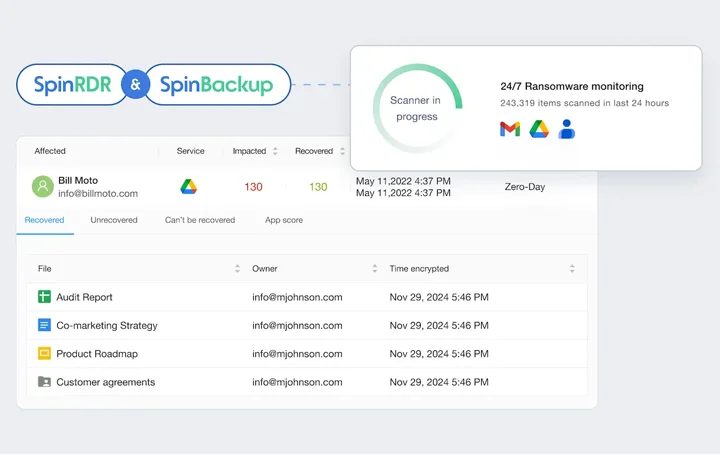
SpinOne RDR is designed specifically to protect SaaS environments against ransomware, insider threats, account compromise, and data loss. The platform focuses heavily on Microsoft 365 and Google Workspace ecosystems, where traditional endpoint security tools often have limited visibility.
Its ransomware detection capabilities rely on monitoring unusual file modifications, suspicious login activity, privilege abuse, abnormal user behavior, and unauthorized data access patterns within SaaS environments.
One of SpinOne’s strongest differentiators is its ability to automatically quarantine malicious activity and recover affected SaaS data without requiring organizations to manage separate backup infrastructure.
Note: SpinOne’s scope is firmly SaaS-native. If your ransomware risk extends to on-premises file servers, hybrid Active Directory, or legacy data stores, SpinOne needs to be paired with tools that cover those environments. It is exceptionally strong at what it does; it simply does not do everything.
Key Features
- Real-time monitoring and automated threat containment in Google Workspace and Microsoft 365
- Root-cause analysis mapped to the MITRE ATT&CK framework
- Selective file recovery from immutable cloud backups
- Automated account blocking without manual intervention
3. Druva Data Resiliency Cloud
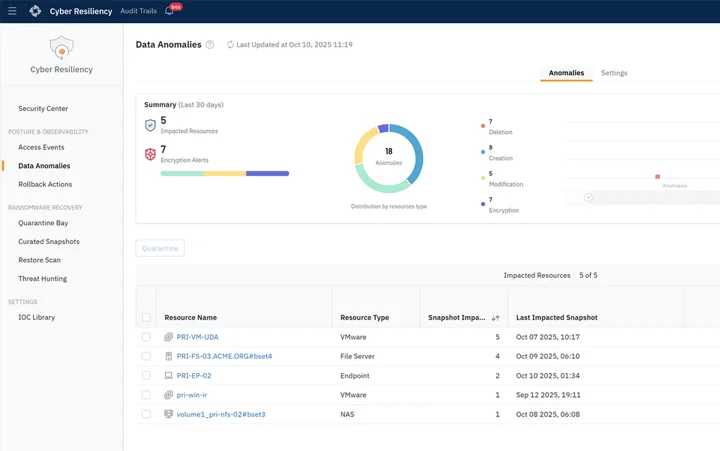
Druva approaches ransomware defense from a cyber-resilience and recovery perspective. Rather than functioning as a traditional detection platform, Druva focuses on protecting business-critical data through cloud-native backup, disaster recovery, cyber recovery, and ransomware recovery capabilities.
The platform helps organizations recover quickly following ransomware incidents by maintaining immutable backups and providing recovery workflows designed to reduce downtime.
Many organizations invest heavily in detection while underestimating recovery readiness. Unfortunately, security teams often discover during ransomware incidents that recovery processes are slower, more fragmented, and more operationally complex than expected.
Key Features
- Isolated, air-gapped cloud storage that cannot be accessed by compromised on-premises credentials
- Automated recovery workflows with granular restoration options
- ML-powered anomaly detection across data access, admin activity, and permissions
- Unified protection across data centers and SaaS applications
4. CrowdStrike Falcon
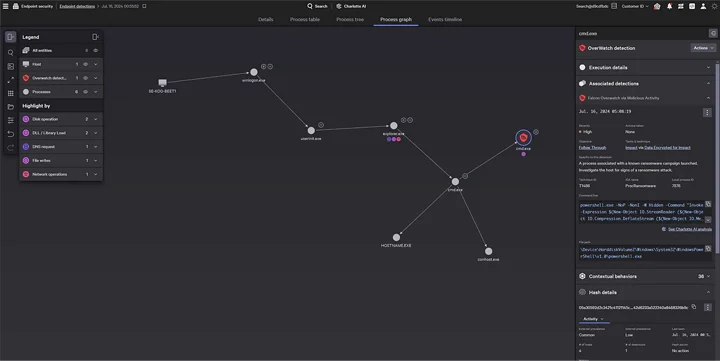
CrowdStrike Falcon is one of the most widely adopted endpoint detection and response (EDR) platforms in the market. The platform combines behavioral analytics, threat intelligence, threat hunting, and automated response capabilities to identify ransomware activity before it causes significant damage.
Its cloud-native architecture and strong threat intelligence capabilities make it particularly attractive for large enterprises with distributed workforces.
Many organizations transition to CrowdStrike after discovering that traditional antivirus products struggle to detect modern ransomware techniques that rely on legitimate administrative tools and living-off-the-land tactics.
Key Features
- AI-driven behavioral prevention and rollback at the endpoint and cloud-workload level
- Managed threat hunting via Falcon OverWatch
- XDR correlation across endpoint and identity signals
- Automated attack containment and lateral-movement blocking
- Device risk scoring integrated with identity context
5. Microsoft Defender for Endpoint
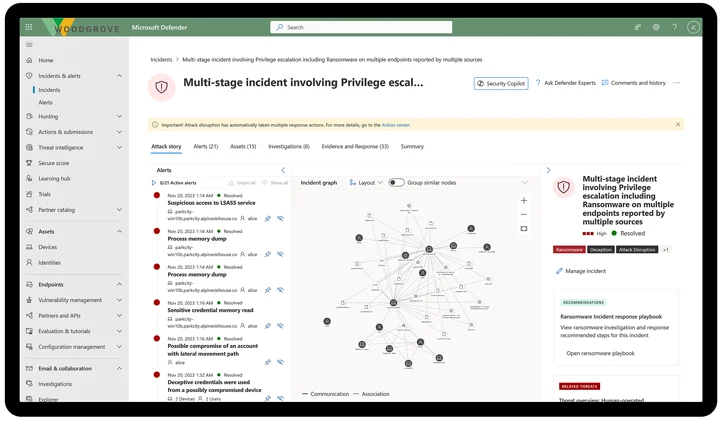
Microsoft Defender for Endpoint has evolved far beyond traditional antivirus. Today, it functions as a full EDR and XDR platform that combines endpoint protection, threat detection, attack-surface reduction, automated investigation and remediation, threat intelligence, and vulnerability management.
The platform integrates deeply with Microsoft Defender XDR, Microsoft Entra ID, Microsoft 365, Azure, and Intune, making it particularly attractive for organizations already invested in Microsoft’s ecosystem.
One of Defender’s strongest differentiators is its Attack Surface Reduction (ASR) framework, which helps prevent common ransomware techniques such as malicious macros, script abuse, and suspicious executable behavior.
Key Features
- Behavioral threat protection and attack-surface reduction
- Automated investigation and response
- Automatic attack disruption for in-progress ransomware events
- Native integration with Microsoft 365, Entra ID, and Azure
- Endpoint and cloud-workload correlation
6. Varonis
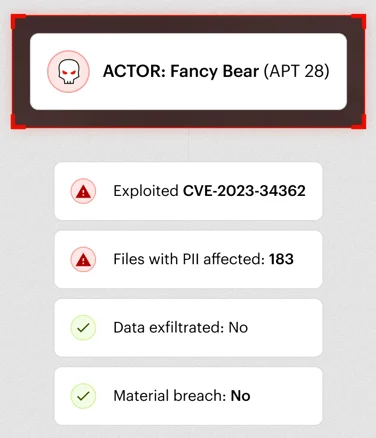
Varonis is fundamentally a data security platform rather than a traditional ransomware prevention product. The platform specializes in monitoring unstructured data environments, analyzing permissions, identifying sensitive data exposure, and detecting abnormal file activity.
Its ransomware detection capabilities are primarily based on monitoring unusual access patterns, excessive file activity, privilege misuse, and suspicious interactions with sensitive data.
Many organizations focus heavily on preventing malware execution while maintaining very limited visibility into how sensitive data is accessed, exposed, copied, modified, or moved across the environment. Attackers often exploit these blind spots long before encryption begins.
Key Features
- Data-centric threat detection tied to sensitive data classification
- User behavior analytics across SaaS, cloud, and on-premises environments
- Forensic investigation and incident timeline reconstruction
- Data discovery, classification, and open-exposure mapping
- Blast-radius reduction through access governance
7. SentinelOne Singularity
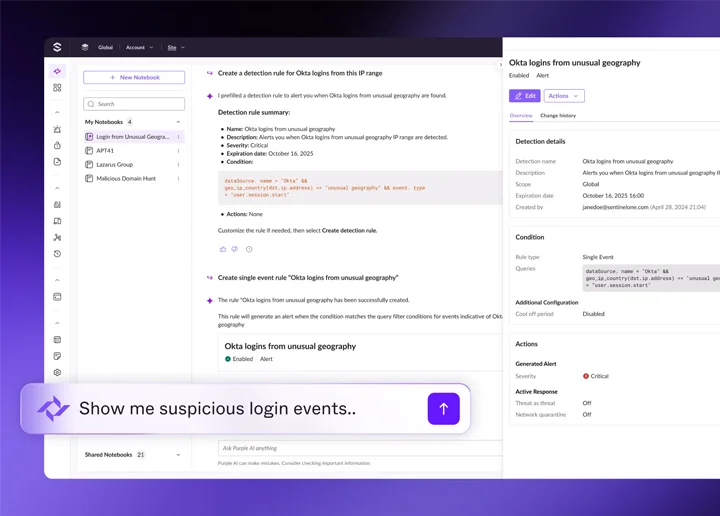
SentinelOne Singularity is an AI-driven cybersecurity platform that combines EDR, XDR, identity security, cloud security, and threat-hunting capabilities.
The platform became particularly well known for its autonomous remediation capabilities. SentinelOne can automatically terminate malicious processes, isolate affected endpoints, quarantine threats, and roll back ransomware-encrypted files using Windows Volume Shadow Copy technology when available.
Its Storyline technology automatically correlates attack events into a unified narrative, helping analysts understand the complete attack chain rather than investigating isolated alerts.
Key Features
- Deep-learning engine for fileless and novel ransomware-variant detection
- Autonomous threat containment and encrypted-file rollback
- Storyline attack visualization for rapid post-incident analysis
- Cloud-workload and endpoint coverage in a single agent
- Analyst-fatigue reduction through automated response
8. Acronis Cyber Protect
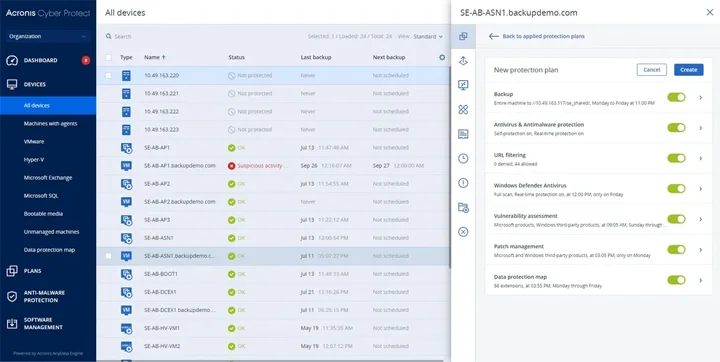
Acronis Cyber Protect combines endpoint protection, backup, disaster recovery, patch management, vulnerability assessment, and ransomware protection within a single platform.
This integrated approach appeals to organizations seeking both prevention and recovery capabilities from a unified solution rather than managing separate security and backup platforms. The platform uses behavioral detection, machine learning, anti-ransomware technology, and backup protection to reduce ransomware impact and accelerate recovery.
Key Features
- Forensic backup with memory and process-state preservation
- Immutable cloud storage for tamper-resistant backup
- AI-powered malware and ransomware detection
- One-click recovery with clean-restore validation
- Full-disk encryption for data at rest
- Unified cyber-protection and backup-management console
9. Rubrik Security Cloud
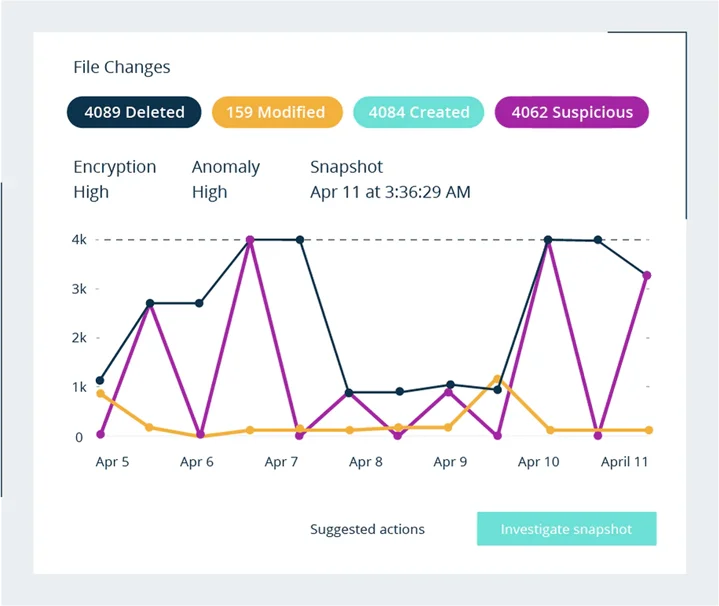
Rubrik Security Cloud focuses heavily on cyber resilience, recovery readiness, ransomware containment, and data recovery.
Rather than functioning as a traditional EDR platform, Rubrik helps organizations reduce ransomware impact through immutable backups, threat monitoring, recovery orchestration, and cyber-recovery workflows.
One of Rubrik’s primary strengths is helping organizations recover clean data quickly while reducing uncertainty during post-incident recovery efforts.
Many organizations discover during ransomware incidents that restoring business operations is often significantly more difficult than restoring data itself. Recovery planning, validation, prioritization, and orchestration frequently become major operational bottlenecks.
Key Features
- Zero-trust immutable backup architecture resistant to privileged-credential compromis
- Sensitive-data discovery and classification integrated into backup analysis
- Automated ransomware investigation with impact scoping
- AI-driven anomaly detection across backup snapshots
- Multi-cloud and hybrid-environment coverage with unified management
10. Bitdefender GravityZone
Bitdefender GravityZone is a multilayered endpoint security platform that combines signature-based detection, machine learning, behavioral analytics, exploit prevention, and EDR capabilities. The platform consistently performs strongly in independent endpoint-protection evaluations and focuses heavily on stopping ransomware before encryption begins.
Bitdefender uses behavioral monitoring to identify suspicious activity such as unauthorized encryption, privilege-escalation attempts, exploit execution, and malware-delivery techniques.
Many organizations assume ransomware detection is purely a malware-identification problem. Modern attacks frequently involve credential theft, privilege abuse, reconnaissance activity, and lateral movement before encryption ever occurs.
Key Features
- Multilayered ML-based ransomware prevention with low endpoint overhead
- Auto-decryption remediation for characterized ransomware variants
- Exploit prevention targeting common initial-access techniques
- Behavioral analysis for unknown and fileless threats
- Network attack defense and lateral-movement blocking
Conclusion
Modern ransomware attacks are no longer simple malware events. Attackers increasingly focus on compromising identities, escalating privileges, discovering sensitive data, expanding access, and disabling defenses before deploying encryption payloads. As a result, effective ransomware defense now requires multiple layers of visibility across endpoints, identities, permissions, sensitive data, SaaS platforms, cloud environments, and recovery systems.
One trend becoming increasingly clear is that many ransomware attacks succeed not because organizations lack security tools, but because they lack visibility into access, permissions, identity activity, and sensitive data exposure. Understanding who has access to what, how permissions change, and how users interact with critical systems often creates earlier opportunities to detect threats before encryption becomes a business crisis.
Organizations that combine strong detection, access visibility, behavioral monitoring, and recovery readiness are often best positioned to reduce ransomware risk and improve cyber resilience.
Frequently Asked Questions
Most early warning signs appear in the identity and permissions layer, including unusual logins, dormant accounts becoming active, unexpected privilege changes, and suspicious access to file shares. These activities often occur before any endpoint-based alerts are triggered.
No. EDR is highly effective at detecting endpoint threats, but it has limited visibility into identity abuse, excessive permissions, and sensitive data access. A strong ransomware defense also requires identity and data-access monitoring.
Yes. Unusual authentication activity, abnormal file-access patterns, privilege-escalation attempts, and suspicious user behavior often occur hours or days before encryption begins. Monitoring these signals can help organizations detect attacks earlier.
Ransomware can only encrypt data that a compromised account can access. Excessive permissions, stale accounts, and over-provisioned access significantly increase the amount of data an attacker can reach and encrypt.
Organizations should focus on covering the entire attack lifecycle, not just encryption and recovery. Alongside endpoint protection, priority should be given to identity monitoring, access governance, and data-activity monitoring to detect attackers earlier in the attack chain.